CorelDRAW is a name synonymous with professional vector graphics editing, offering a robust suite of tools for illustrators, designers, and production artists. Developed and marketed by Corel Corporation, it has evolved from its humble beginnings into a comprehensive platform serving diverse industry needs. This article delves into the rich history, extensive features, and widespread applications of CorelDRAW Graphics Suite, exploring its journey from early Windows environments to its current multi-platform support.
Genesis of a Vector Icon
The story of CorelDRAW begins in 1987 when Corel engineers Michel Bouillan and Pat Beirne embarked on a mission to create a vector-based illustration program. Their vision was to bundle this innovative software with their existing desktop publishing systems. The result was CorelDRAW, first released in 1989. Initially, CorelDRAW 1.x and 2.x operated under Windows 2.x and 3.0. However, it was with the release of Microsoft's Windows 3.1 that CorelDRAW 3.0 truly came into its own, marking a significant step in its development and adoption.
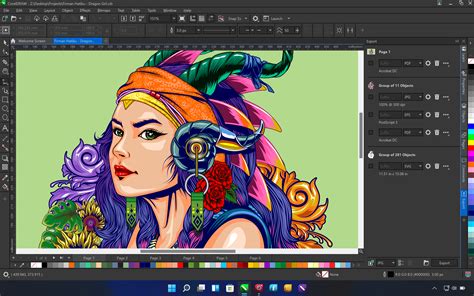
The early iterations of CorelDRAW laid the foundation for its powerful capabilities. CorelDRAW 3.0 introduced groundbreaking tools that would become staples of vector design. Among these were the Envelope tool, which allowed for distorting text or objects using a primary shape; the Blend tool, enabling the morphing of shapes; the Extrusion tool, for simulating perspective and volume in objects; and the Perspective tool, designed to distort objects along X and Y axes. This version also saw the inclusion of a suite of related graphics programs, such as Corel Photo-Paint for bitmap editing, CorelSHOW for creating on-screen presentations, CorelCHART for graphic charts, and CorelTRACE for vectorizing bitmaps. This comprehensive package solidified CorelDRAW's position as a versatile design solution.
Evolution Through the Decades: Key Milestones
As technology advanced, so did CorelDRAW, with each new version building upon the last, introducing innovative features and adapting to new operating systems.
The 32-Bit Era and Macintosh Debut
CorelDRAW 6, released in 1995, represented a significant leap forward. It was the first version designed for 32-bit Windows, offering enhanced performance and stability. Crucially, this version also marked CorelDRAW's debut on the Macintosh platform, expanding its reach to a wider user base. New features introduced with version 6 included a customizable interface, the Polygon, Spiral, Knife, and Eraser tools, a context-sensitive Property bar, Print Preview with Zoom and Pan options, a Scrapbook for viewing and dragging graphic objects, and the ability to Publish to HTML. Interactive Fill and Blend tools, Transparency tools, and the Natural Pen tool further enhanced its creative capabilities.
Refinements and Expanded Functionality
Subsequent versions continued to refine the user experience and expand the software's potential. CorelDRAW 7 introduced Docker windows for organized tool access and interactive distortion, 3D, Envelope, and Perspective tools. It also featured a Realistic Dropshadow tool, interactive color mixing, a color palette editor, guidelines as objects, custom-sized pages, and duotone support.
CorelDRAW 8 brought the Mesh fill tool, enabling complex color filling, and the Artistic Media tool, offering a range of creative brush strokes. The suite also included Publish to PDF features, embedded ICC color profiles for accurate color management, multiple on-screen color palettes, and support for Microsoft Visual Basic for Applications 6, allowing for scripting and automation.
CorelDRAW 9 integrated Canto Cumulus LE, a media management software, and introduced Corel R.A.V.E. for vector animation, Perfect Shapes, Web graphics tools for creating interactive elements, a Page sorter, multilingual document support, and a navigator window.
CorelDRAW 10 featured the innovative Double-click Crop tool, which was the first vector software capable of cropping groups of vectors and bitmap images simultaneously. It also introduced the Smart fill tool, Chamfer/Fillet/Scallop/Emboss tools for shaping objects, and the Image Adjustment Lab for quick photo enhancements. A significant addition was the inclusion of OpenType versions of popular font families from Linotype foundry, replacing their Bitstream counterparts.
The X-Factor: A New Naming Convention and Power
The introduction of the "X" naming convention with CorelDRAW X3 (version 13) marked a new era. CorelDRAW X3 brought enhanced capabilities for large-format printing, including Border and Grommet and Canvas Prep and Stretch tools. It also offered improved support for high-resolution displays with scalable icons and UI elements.
CorelDRAW X4 continued this evolution with a new Unicode OpenType-based text engine, modernizing text handling and providing full international language support while retaining the legacy text mode. Dynamic alignment guides facilitated easier object placement, and the CorelConnect content organizer allowed in-app access to online resources like Flickr for images and clip art. New tools for pushing, pulling, and smearing vector objects, along with new default workspaces tailored for different user roles and new training videos, enhanced user productivity and learning.
CorelDRAW X5 introduced a new Font List selection filtering system, with Corel Font Manager replacing the older Bitstream Font Navigator. It also allowed users to hide objects and groups, not just layers, and enabled copying and pasting portions of curve segments. Improvements included adjacent node selection, an enhanced Knife tool, a photo retouching Healing tool, an improved perspective correction tool, and enhanced feathering on drop shadows.
CorelDRAW X7 notably introduced 30-day and 365-day rental (subscription) options as an alternative to the traditional perpetual license purchase, reflecting a shift in software distribution models.
CorelDRAW X8 focused on enhanced collaboration with a suite of tools including Copy editing, a Comments Docker, Annotation tools, and Cloud client sharing. It also offered more non-destructive photo editing features and filters, combined photo editing with presets, new templates, a new multipage tool, and more multiple-format export options.
Modern Era: Cloud, AI, and Multi-Platform Support
CorelDRAW Graphics Suite 2018 continued the trend of innovation with new curve-editing tools, updated Pantone support, and significant bug fixes and stability enhancements.
CorelDRAW Graphics Suite 2019 brought the Advanced PDF Printing feature and improvements to the Paintbrush tool, alongside broader stability and security enhancements. A major milestone was the return of CorelDRAW to the Mac platform after nearly two decades, with support for macOS Mojave Dark Mode and Touch Bar.
CorelDRAW Graphics Suite 2020 further refined the user experience with a focus on productivity. The suite included a new multipage tool, allowing for seamless management of multiple pages within a single document, and enhanced export options for various formats.
CorelDRAW Graphics Suite 2021 introduced native support for the latest operating systems, including Windows 11 and macOS, with a specific focus on the exceptional performance of Apple silicon. This version also brought significant updates to the suite's AI-powered features, including a new AI-powered image generation tool, "AI Generate," which allows users to create custom visuals from text descriptions. Subscribers and maintenance customers receive monthly AI credit allowances to power these generative AI features, while perpetual license holders receive a fixed allotment. The suite also boasts a refreshed interface, improved stability and performance, and faster app launch times.
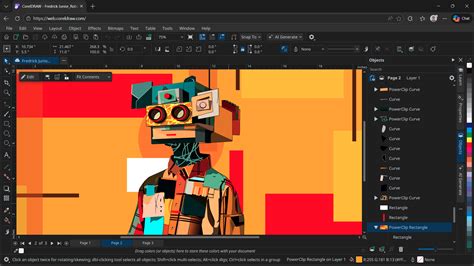
The most recent iterations, such as CorelDRAW Graphics Suite 2026, continue to push the boundaries with intelligent tools that accelerate ideation and improve workflow. Beyond AI advancements, these versions offer a refreshed interface, significantly improved stability and performance, and flawless publishing and output. Access to free integrated Pantone Color palettes in both CorelDRAW and Corel PHOTO-PAINT remains a cornerstone of the suite. Non-destructive editing capabilities for both bitmaps and vectors, including block shadows, symmetrical illustrations, and perspective drawings, empower users to experiment freely. The suite also provides a consolidated view for managing all project assets, offering a fluid creative environment.
Platform and Compatibility: A Broad Reach
Historically, CorelDRAW demonstrated remarkable platform adaptability. It was originally developed for Microsoft Windows 2.1 and saw versions released for Windows 3.1x, CTOS, OS/2, and Power Macintosh. Notably, Hewlett-Packard announced a version of CorelDRAW for its HP 9000 Series workstations running HP-UX. With the release of Corel Linux, CorelDRAW 9 was made available with package support for Debian and Red Hat-based Linux distributions. Version 11 was released for Mac OS X in 2001 but was subsequently discontinued on both Linux and Mac platforms for a period.
As of recent versions, CorelDRAW Graphics Suite offers robust support for Windows 10, Windows 11, and macOS, including a dedicated release optimized for Apple silicon. Furthermore, a related web app and iPad app provide online collaboration and markup functionalities, extending the suite's reach beyond traditional desktop environments.
Scripting and Automation: Enhancing Productivity
CorelDRAW has long supported task automation to enhance user productivity. With version 6, Corel introduced task automation through a proprietary scripting language, Corel SCRIPT. Support for Visual Basic for Applications (VBA) macros was added in version 9, and Corel SCRIPT was eventually deprecated in favor of VBA. This scripting capability allows users to automate repetitive tasks, create custom tools, and extend the functionality of the software.
The CDR File Format: A Deep Dive
The CorelDRAW file format, CDR, has undergone significant evolution. In its early versions, CDR was a proprietary file format primarily used for vector graphic drawings, identifiable by the first two bytes of the file being "WL".
Starting with CorelDRAW 3, the file format transitioned to a Resource Interchange File Format (RIFF) envelope, recognized by the first four bytes being "RIFF" and "CDRvrsn" in bytes 9 to 15 (where "" was a blank in early versions). Beginning with CorelDRAW 4, the file format began including the version number of the writing program in hexadecimal. From version X4 (14) onwards, the CDR file structure changed to a ZIP-compressed directory containing various files, including XML files and the RIFF-structured riffdata.cdr. The version signature within this file also evolved, with versions X4 and X5 using "CDREvrsn" and "CDRFvrsn" respectively, and CorelDRAW X6 using a root.dat file with a slightly different byte signature ("CDRGfver").
The proprietary nature of the CDR format led to efforts in reverse engineering. The sK1 open-source project team began reverse-engineering the CDR format in December 2006, presenting their findings and a working snapshot of a CDR importer at the Libre Graphics Meeting 2007. The sK1 project also developed the UniConvertor, a command-line open-source tool capable of converting CorelDRAW formats (CDR/CDT/CCX/CDRX/CMX) from versions 7 to X4 into other formats. In 2012, the LibreOffice/re-lab team implemented libcdr, a library for reading CDR files from version 7 to X3 and CMX files, offering support for shapes, properties, color management, and spot colors, with basic text support. This library also provides converters to SVG and OpenDocument formats.
While Adobe Illustrator and other vector graphics software have varying levels of support for importing CDR files, direct compatibility can sometimes be limited, especially with newer versions of the CDR format. Users often rely on intermediate formats like SVG or PDF for seamless cross-application workflows.

CorelDRAW Graphics Suite: More Than Just Draw
CorelDRAW Graphics Suite is a comprehensive package that extends beyond its flagship vector illustration application. It typically includes:
- CorelDRAW: The primary vector illustration and page layout application.
- Corel PHOTO-PAINT: A powerful bitmap image editor for photo editing and digital painting.
- Corel Font Manager: A tool for organizing, managing, and previewing fonts.
- PowerTRACE: A utility for converting bitmaps into editable vector objects.
- Corel CAPTURE: A utility for screen capture.
- CorelDRAW.app: A web-based application for collaboration and design on the go.
The suite also often includes a vast library of fonts, clip art, templates, and other digital assets, enhancing the creative possibilities for users.
Industry Applications and User Base
CorelDRAW Graphics Suite is a versatile tool used across a wide spectrum of industries:
- Signmaking and Vinyl Cutting: Its precise vector tools are ideal for creating designs for signs, banners, and vinyl decals.
- Screen Printing and Apparel: CorelDRAW is widely used for designing graphics for t-shirts, merchandise, and other printed textiles.
- Laser Cutting and Engraving: The accuracy of vector outlines makes it suitable for programming laser cutting and engraving machines.
- Print-on-Demand: Designers leverage CorelDRAW for creating artwork for various print-on-demand products.
- Digital Painting and Illustration: Artists use CorelDRAW and Corel PHOTO-PAINT for creating digital illustrations and artwork.
- Desktop Publishing: The suite's layout capabilities are employed for brochures, flyers, and other marketing materials.
- Engineering, Manufacturing, and Construction: CorelDRAW is a trusted name in these sectors for technical drawings and schematics.
- Graphic Novel Creation: As exemplified by Bitsy & Company, CorelDRAW is used for character creation and layout in storytelling.
- Custom Signage Solutions: Industry leaders utilize CorelDRAW Graphics Suite to serve the printing needs of major corporations.
CorelDRAW Graphics Suite is recognized as a powerful alternative to comparable graphic design software, offering a balance of ease of use and professional-grade features. Its flexible purchasing options, including subscriptions and one-time purchases, cater to diverse user needs and budgets.
How to use the Block Shadow tool in CorelDRAW for Vinyl Cutters & Sign making
Purchasing Options and Licensing
CorelDRAW Graphics Suite offers flexible purchasing options to suit different user requirements and budgets. These typically include:
- Subscription Model: A recurring payment (monthly or annual) that provides access to the latest version of the software, ongoing updates, new features, and exclusive content. Subscribers and maintenance customers often receive a monthly allowance of AI credits for generative AI features.
- One-Time Purchase (Perpetual License): A single payment for permanent ownership of a specific version of the software. Perpetual licenses grant long-term use but do not include ongoing support for future operating systems, devices, or technologies. Customers with one-time purchases receive a fixed allotment of AI credits that do not expire but do not renew.
- Maintenance Plan: An optional annual payment that can be added to a perpetual license. This plan ensures eligibility for the most up-to-date version of CorelDRAW Graphics Suite, along with access to new features, apps, content, and monthly AI credits, at no additional cost, as long as the maintenance remains active.
CorelDRAW Graphics Suite is not a free product, but the company offers an obligation-free 15-day trial, allowing potential users to explore its capabilities before committing to a purchase. Additional AI credits can be purchased through various add-on options, including monthly or annual subscriptions, or one-time credit packs.
It is important to note that the company assures users that their creative work within CorelDRAW is never used to train its AI features or third-party AI models.
Conclusion
CorelDRAW Graphics Suite stands as a testament to enduring innovation in the field of graphic design. From its foundational vector editing capabilities to its integration of advanced AI tools and multi-platform support, it continues to empower creative professionals worldwide. Its rich history, extensive feature set, and adaptability across various industries solidify its position as a leading solution for vector illustration, page layout, photo editing, and typography.