In today's increasingly digital world, background checks have become an integral part of personal and professional life. From securing employment and housing to obtaining loans and even engaging in volunteer work, the information gleaned from these screenings can significantly impact opportunities. However, for individuals with past legal issues, a criminal record can cast a long shadow, creating persistent roadblocks. Fortunately, a landscape of legal solutions exists to help individuals move forward without the perpetual burden of past mistakes. This article delves into the intricacies of background check removal, expungement, record sealing, and the services available to help individuals reclaim their privacy and future.

Understanding the Landscape: What Appears on a Background Check?
Clearing your record from background checks begins with a fundamental understanding of what information is being reported and where it appears. Employers, landlords, and licensing boards often rely on comprehensive reports compiled from various sources. To effectively navigate this process, it's crucial to first ascertain what these entities actually see.
The initial step often involves ordering your own reports from common background check providers. These services frequently draw from public records and private database copies. Employment screeners such as Checkr or HireRight, tenant-screening platforms, and volunteer-check services are generally obligated under the Fair Credit Reporting Act (FCRA) to provide you with a copy of any report used to make a decision about you.
Running your own background check is more than just obtaining a single report. Once you have these copies, a thorough review is essential. Look for errors or outdated information, such as incorrect dispositions, charges that were dismissed, cases that have been expunged but still appear, or even another person's record mistakenly merged with yours. Meticulously mark every item that is incorrect or extends beyond legal reporting limits. This detailed examination forms the bedrock for any subsequent removal or correction efforts.
Arrests Versus Convictions: A Crucial Distinction
It's important to understand that arrests and convictions are often treated differently on background checks, though both can surface in private systems. An arrest may appear in police and commercial databases even if prosecutors never file charges. Similarly, court records might indicate that a case was filed and subsequently dismissed. Commercial background-check vendors aggregate data from public and semi-public sources, making inaccuracies or outdated information a common occurrence. A 2024 SHRM study highlighted that the presence of any criminal record significantly affects hiring decisions for most employers, even when charges did not lead to a conviction.
Legal Pathways to Record Clearing: Expungement and Record Sealing
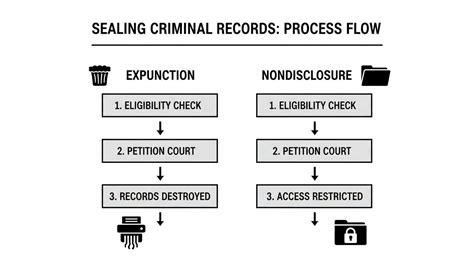
Once you have a clear picture of what appears on reports, the next critical question is whether you qualify to clear, seal, or expunge your record under state law. While definitions can vary, "expungement" generally refers to a legal process that restricts public access to arrest records, convictions, and court records once specific statutory conditions are met. Record sealing, while similar, is a slightly narrower concept.
Filing to clear or expunge a criminal record is a navigable process when broken down into practical steps. The first involves assessing your eligibility under state law. This determination depends on the offense type, the waiting periods prescribed by statute, and whether another remedy, such as record sealing or a set-aside, might apply.
Expungement in Kansas: A Closer Look
In Kansas, expungement and record sealing are governed by state laws that meticulously outline which offenses are eligible, the requisite waiting periods, and the precise filing procedures. Understanding these rules is paramount before attempting background check removal, as outdated or incorrect assumptions can significantly delay desired outcomes. Expungement is a court-ordered remedy that restricts public access to a criminal case. Essentially, once granted, the law treats the case as if it never occurred for most civilian purposes, although specific exceptions exist. This impacts how your history appears in public records and consumer reports. Record sealing is more limited; sealed records are hidden from public view and most background checks but remain accessible to certain designated agencies. Many legal and record-clearing services integrate expungement, record sealing, and set-asides into a unified strategy. Facts about expungement in Kansas are derived from state statutes and local court procedures. Waiting periods typically range from three to five years after the completion of the sentence, payment of fines, and any probationary supervision.
The Impact of Expungement and Sealing
Expungement is particularly valuable as it translates legal relief into tangible everyday opportunities. For employment, expungement can broaden prospects by preventing routine background checks from surfacing dismissed or old convictions. It also significantly supports an individual's reputation and provides invaluable peace of mind. Record sealing, while not always as comprehensive as expungement, still effectively hides records from public view and most background checks, offering a crucial layer of privacy.
When a judge grants relief, a final order is issued that limits public access to the record. This typically removes it from most employment and housing background checks. However, it's crucial to note that law enforcement and certain other agencies may still retain access to this information under defined circumstances.
Timelines and Expectations: The Reality of Record Clearing
Timelines are a critical consideration, especially when a job offer or lease agreement hinges on the outcome of a background check. The period required to file a petition and receive a ruling can range from several weeks to months, depending on the specific court's caseload and whether you have multiple cases to address. Once relief is granted, courts and agencies then require additional time to update public records, statewide repositories, and online portals.
An expedited record clearance update can help shorten this delay. This proactive approach involves directly contacting data brokers and background check companies with certified copies of court orders. However, even with expedited services, complete cleanup is rarely instantaneous. Many individuals express frustration when a dismissed or expunged case continues to appear on a report or in an online search.
The typical lifecycle of a record begins when law enforcement makes an arrest, and the court subsequently opens a case. Arrests versus convictions on background checks are often treated differently, but both can manifest in private systems. Understanding the distinct types of records involved is key to setting realistic expectations about what background check removal services can achieve.
Public Records vs. Private Databases
At the core of this issue are courthouse records and state repositories, which constitute official public records. Court dockets, online court portals, and clerk's offices reflect the current legal status of a case, including any dismissals, diversions, or expungements.
Private database copies are a different entity. Data brokers and background check companies compile "snapshots" of public records and create their own proprietary files. These files remain in their systems until they are updated or purged. These private databases then feed into employment background checks, tenant-screening reports, volunteer screens, and other consumer reports.
Even after expungement or sealing, exceptions for law enforcement and certain employers, along with specific limits for these agencies and licensing bodies, can allow access to sealed or expunged information in defined circumstances. It's also important to recognize that not all background checks adhere to the same legal frameworks or reporting standards. Third-party employment screeners, for instance, must comply with the FCRA. Generally, non-conviction records older than seven years are restricted from reporting. Convictions, however, may be reported for longer periods unless state law imposes stricter limitations. In most states, expunged or properly sealed records should not appear on consumer reports, although disclosure rules can vary significantly by agency and employer.
The Role and Limitations of Background Check Removal Services
Background check removal services aim to assist individuals in correcting, suppressing, or removing inaccurate and outdated records from consumer reporting agencies and online databases. A professional background check removal process typically focuses on the private-sector and online implications of an individual's record.
What Services Can and Cannot Do
These services can be instrumental in helping take down information from public and private databases, online people-search sites, and other non-government sources. However, it's crucial to understand their limitations. Official government records often remain accessible to law enforcement, courts, and certain licensing agencies, irrespective of private database removal efforts.
Expungement is not always a prerequisite for removal services, but it significantly strengthens removal requests. Expungement legally seals or clears certain records, making it considerably easier for services to have them removed from public and private databases.
It's also vital to recognize that removal is not always permanent. Even after a background check removal service successfully removes or suppresses records, the information may reappear. This can happen because databases are regularly updated, or reporting errors may occur.
The "Easy Eraser" Example
Services like "The Easy Eraser" aim to remove criminal records and other private, personal data from a significant number of online databases, often within 30 days, though sometimes up to six weeks for complete removal across all companies. These services remove personal information, including criminal records, from commonly used online databases. However, it's important to note that such services do not typically provide the legal rights that accompany a court order for sealing or expunging a criminal record. For instance, when a court orders an offense sealed or expunged, the subject of the record often gains the right to prohibit private entities from possessing or disseminating that information, and in many situations, can even legally deny the arrest ever occurred. Services like The Easy Eraser primarily focus on removing information from databases, thereby reducing, but not eliminating, the likelihood of a criminal record negatively impacting an individual.
Background Check Removal (BCR) and Background Check Defense (BCD)
Some providers offer a dual approach, such as Background Check Removal (BCR) and Background Check Defense (BCD). BCR targets a group of non-regulated background check companies, often covering around 30 popular sites, with the list subject to change. This service does not require an expungement or a court order of relief, making it accessible to a broad audience. While BCR cannot guarantee removal from every single site if it's not on their list, they will investigate available options. A key feature of BCR is a 45-day guarantee: if information reappears on covered sites within that period after service completion, they will remove it again.
BCD, on the other hand, focuses on regulated companies, including major players like TransUnion Smartmove, HireRight, Checkr, Sterling, and GIS. This service provides expert support to challenge or appeal any regulated background check that does not accurately report an expungement or sealing. BCD is particularly important because many commonly used background check companies do not allow individuals to request a background check before applying for a job that requires one.
Introduction to Non-Regulated Background Checks
Regulated Versus Non-Regulated Background Checks: A Critical Distinction
Understanding the difference between regulated and non-regulated background checks is crucial. Regulated background check companies operate under the Fair Credit Reporting Act (FCRA). Under FCRA, employers may be allowed to see certain expunged or sealed cases. A significant advantage of regulated checks is that if a background check is pulled, you have the right to contest it before the employer makes a decision based on the record. Services like BCD assist in contesting incorrect background checks with regulated companies within the stipulated timeframe, typically seven days, by helping you present proof of expungement or record sealing.
Conversely, an unregulated background check cannot be legally used by an employer to make a hiring decision, nor can it be used by landlords. While unregulated check sites might be used illegally, potentially causing legal trouble for employers or landlords, they are often used by neighbors or acquaintances for a nominal fee and easy access. Fortunately, most unregulated sites, such as BeenVerified and InstantCheckmate, offer opt-out options. Services like BCR are designed to effectively and efficiently opt individuals out of these unregulated background checks, ensuring that people close to you do not find outdated or embarrassing information.
The Cost of Clearing Your Name
Cost is a significant concern for anyone exploring record clearing services. Expenses generally fall into three main categories: court-related fees, legal fees, and background check removal or expedited update service fees. When clients inquire about the cost of expungement, the answer often encompasses both filing fees and the cost of legal representation. Some services may have additional fees, for instance, an extra charge if an expungement was completed by another law firm. Monthly payment plans are also sometimes available for certain services, requiring an initial deposit.
Beyond Criminal Records: Addressing False Accusations and Digital Footprints
False accusations can leave lasting scars long after an investigation is closed or charges are dropped. Employers increasingly rely on background checks, reference checks, and online searches when making hiring and promotion decisions. Even an unproven allegation that led to an arrest, an internal investigation, or a suspension can raise red flags for hiring managers, particularly in fields that demand a high degree of trust, such as finance, healthcare, or education.
Licensed professionals, including doctors, nurses, teachers, attorneys, and financial advisors, may face mandatory reporting obligations when accusations are made. Licensing boards can initiate disciplinary investigations based solely on complaints, arrest reports, or media coverage.
Immigration and Family Court Ramifications
Immigration consequences can be particularly severe. Allegations related to crimes of moral turpitude, domestic violence, or controlled substances can impact visa renewals, green card applications, and naturalization processes, even if cases are ultimately dismissed. Family courts handling custody or visitation matters often approach allegations of abuse or neglect with extreme caution. The dangers of a false accusation on your record are amplified when considering the types of records that exist: arrest records, court dockets, and conviction records are distinct.
Digital Reputation Management
Rebuilding one's reputation after a wrongful accusation often necessitates both legal and digital strategies. Where content is demonstrably false or violates platform policies, attorneys can issue takedown requests, send demand letters, or obtain court orders to compel removal or correction. Digital reputation management focuses on reducing the visibility and impact of harmful content that cannot be easily removed through direct takedown. Online defamation and false accusations frequently leave digital tracesâmetadata from posts, edits, or coordinated campaignsâthat digital forensics experts can meticulously analyze.
Ongoing Vigilance: Monitoring Your Record
Monitoring your background record is not a one-time task; it's an ongoing process. Regularly reviewing reports from major background check providers, court systems, and people-search sites helps you identify and address errors early. Long-term protection also involves tracking expunged or sealed cases, monitoring search results, and engaging with professionals when necessary.
Even after expungement and dedicated removal efforts, background checks can sometimes display old or incorrect information. Questions like "Why is my background check showing old or incorrect information?" or "Why is my criminal record still showing up online?" often trace back to data-broker snapshots that have not been refreshed. Whether you can remove accurate but old information from background checks depends on reporting limits under the FCRA and state law, as well as the specific rules for reporting arrests versus convictions.
According to a 2024 American Bar Association study on expungement outcomes, a significant share of expunged cases still appear on private background checks at least once after relief is granted. However, consumers who file documented disputes under the FCRA succeed in having errors corrected in a majority of cases.
Exercising Your Dispute Rights Under FCRA
When a background check report contains errors, the FCRA grants you specific rights. You can send a written or online dispute directly to the background check company. It is highly advisable to keep a meticulous record of the dispute process, perhaps using tools like Microsoft Excel or Google Sheets. Documenting your efforts creates a valuable record that can be shared with regulators or legal counsel if errors are not promptly corrected.
Permanence and Proactive Strategies
Timelines and permanence are two of the most frequently asked questions in any background check removal discussion. Most projects require a few weeks to identify all relevant sources, submit documentation, and process the initial round of removals. Some data brokers respond within days, while others adhere to fixed monthly or quarterly update cycles. Expedited updates can shorten the process, but they cannot override internal schedules at every company.
When individuals inquire whether background check removal is permanent, the honest answer is that permanence is rarely absolute. Questions such as "Will my information come back after I opt out?" highlight the critical need for ongoing support and monitoring. Listening to your record and removing background check entries is merely the first step. Proactive strategies include removing yourself from people-search sites, utilizing data removal services for bulk opt-outs, setting up Google Alerts for your name, periodically requesting reports from background check companies, and securely storing copies of your expungement or sealing orders.
Even after expungement, data brokers may retain outdated information. A background check removal service bridges the gap between legal relief and real-world results. By confirming reports, securing legal relief, and coordinating database updates, individuals can significantly reduce delays and protect their future opportunities.
Partnering for Success
Choosing a background check removal or reputation management partner is as important as selecting legal counsel. Providers that blend legal awareness with technical skills in search, structured data, and data-broker systems generally achieve the most favorable outcomes. Transparent flat-fee pricing, detailed service descriptions, and customized solutions for your specific situation tend to indicate higher-quality operations compared to vague or open-ended fee structures.
Lifeback Legal, for example, is a division of the Law Firm of Randall & Johnson, a trusted California Law Firm, offering comprehensive services from gathering documentation to dealing with court procedures. They emphasize going beyond simply expunging court records to address the impact of outdated and embarrassing information on employers' and landlords' internet searches.
The legal process to describe petitioning for record clearing is typically called expungement. After it is granted, a record expunged from a person's criminal history has effectively been reversed. For most people, the court records that reflect that specific case mean the record has cleared, and the information associated with it has changed its status. A crucial fact that cannot be understated is that the criminal record expungement information within court records must be free of clerical errors. After a successful petition for expungement is ordered, an individualâs first step in privacy begins. The criminal charges and the record of conviction become non-reportable to almost any kind of legal background check conducted by employers. Thus, to expunge criminal records means to legally remove them from their âconvictionâ label and replace it with dismissal. As always, there are exceptions; sex crimes are often excluded from criminal record expungement relief. After the petition is filed, the court must find good cause to grant the request. A lesser-known and often forgotten category of sealed record can be dismissed charges; many with drug possession offenses qualify for highly beneficial programs that throw the case out of court entirely. Some of the most groundbreaking laws have been passed in the past few years that remove the petition-based barrier for many with conviction histories. These laws promise to clean criminal histories automatically, and many are working exactly as they should be. For starters, many defendants do not know one way or another if they are the beneficiaries of these largely hidden procedures.
Our privacy architecture was developed intentionally to operate within the criminal data ecosystem. However, RecordFixer would not be effective if we simply shot in the dark and hoped for the best. It takes years of industry know-how, consumer privacy laws, operating inside criminal courts, and spotting trends within the background check industry. One example that comes to mind are state record repositories â typically governed by the Department of Justice. Sealed and expunged records are still âseen,â but only to those with access to agency resources. However, effective clearance is registered in these systems and reflects the true nature of oneâs history. What this means is that we have made it possible to achieve the most effective record clearance of your criminal history from hundreds of background check sources (both private and publicly available). It is therefore crucial to approach record clearance with realistic expectations, understanding that complete eradication of information from background checks may be a complex and ongoing process. Which makes the first and second steps that much more important. Clearance procedures in the courts will still be reflected in these systems. But most of our neighbors donât have accounts with Central Intelligence or the Pentagon. Whatâs our point? Remove your records from the most likely sources that will cause you trouble with employment and your personal reputation. Having a criminal record can have severe consequences on various aspects of your life, especially when it comes to job prospects and getting closer to individuals that want to look you up. Critical procedures exist for millions of people to take advantage of immediately. A legal document does not necessarily mean it must be a court order. But in the context of criminal record privacy, documents such as official court dismissal orders, docket minute orders, expungement/expunction petitions, certificates of detention, and non-prosecution letters all play crucial roles. Each individual case will have a different level of privacy attached to it.
A word of caution to anyone looking for services or experts who offer you the ability to erase yourself from all systems (consumer, legal, public, and private databases). There are tens of thousands of justice-based database systems in the US, and hundreds of thousands of consumer databases that can be anything from a credit bureau to a loyalty account at your local tire repair shop. This list is almost endless and practically impossible to trace. Therefore, be very mindful of any claims that promise to completely eradicate all possible traces of any records associated with you.
The advent of the Internet has made it possible for anyone to have quick and easy access to criminal records and other personal information. There are two types of databases which store such information: public databases and private databases. You may have records in both types of databases that you want removed, and each of them has a different process for record removal. Public databases such as the Department of Justice (DOJ), Department of Public Safety (DPS), courthouses, and police stations require a granted court order for the sealing or expungement of your criminal case to remove your record and are updated automatically upon receiving the court order. After your petition for criminal record clearing is granted, the court clerk will send you or your legal representation the signed court order. The court will update their records of your granted order within 48 hours. The DOJ and DPS must then update their records within 30 days of receiving the order. Most background check companies get their information from these public databases.
Private databases, which include online background checks, update records at their own discretion. Private databases can update in waves, meaning anywhere between six months to one year, depending on the company's enforcement of record updates. Some private databases may not ever be compelled to update their records to reflect your granted order, unless they are actively enforced to do so. Most people clear their criminal records so that they can pass background checks for employment, housing, universities, and loans, or to restore rights in order to vote or own a firearm. Unfortunately, even after the court grants your request for record clearing, employers and landlords may still be discriminating against you as an applicant. Regardless of whether the court ordered for your criminal record to be expunged or sealed - which makes it as though the offense and related incidence did not occur - there is nothing to prevent someone from holding your cleared record against you if they still have access to the private database records. Both clearing your criminal record and then ensuring that the granted court order has been updated on both public and private databases is the only way to guarantee that your past will stay where it belongs, in the past. Do not allow your expunged criminal record, which will automatically be cleared from public records, haunt your future by continuing to appear in private databases. The Law Firm of Higbee & Associates offers an Expedited Record Clearance Update (ERCU) that updates the leading 600 private background check companies within 14 days of receiving an individual's granted order.
tags: #background #check #removal #service