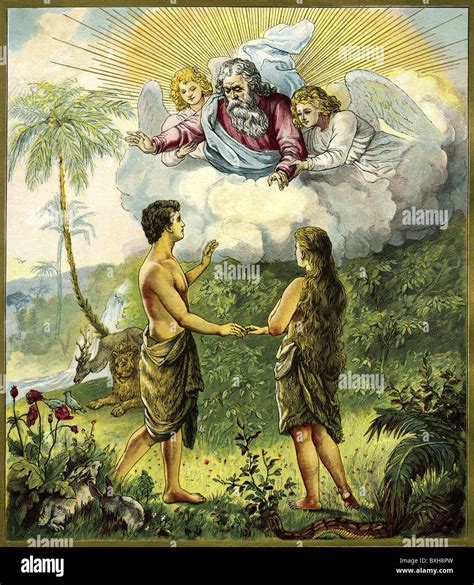
The concept of procreation, the act of bringing forth new life, is a theme deeply woven into the fabric of biblical narrative and theology. From the very beginning of creation, the imperative to "be fruitful and multiply" echoes through scripture, underscoring its significance in God's plan for humanity and the natural world. This divine injunction, bestowed upon the first man and woman, Adam and Eve, was not merely a biological directive but a foundational blessing and a call to participate in the ongoing work of creation.
The Genesis Mandate: "Be Fruitful and Multiply"
The foundational text for understanding biblical perspectives on procreation lies within the Book of Genesis. In Genesis 1:24-26, God declares, "Let the earth bring forth the living creature according to its kind: cattle and creeping thing and beast of the earth, each according to its kind." This command extends to the pinnacle of creation, humanity. Genesis 1:28 states, "God blessed them. And God said to them, 'Be fruitful and multiply and fill the earth and subdue it, and have dominion over the fish of the sea and over the birds of the heavens and over every living thing that moves on the earth.'" This initial decree signifies that procreation was intrinsically linked to God's purpose for humanity: to populate the earth and exercise stewardship over it.
The creation narrative emphasizes the deliberate design of humanity for this purpose. "So God created man in his own image, in the image of God he created him; male and female he created them" (Genesis 1:27). This creation of distinct male and female beings, designed for union, highlights the biological and relational foundation for procreation. The subsequent blessing of fruitfulness underscores that this was not an afterthought but a core aspect of God's intention for human existence.
The early chapters of Genesis also illustrate the immediate implementation of this mandate. Following the creation of Adam and Eve, the narrative implicitly moves towards their union and the continuation of the human race. While specific details of their early life are not elaborated upon in terms of procreation, the subsequent genealogies and the mention of Adam and Eve having "sons and daughters" (Genesis 5:4) indicate the natural unfolding of this divine command.
Procreation as a Divine Gift and Blessing
Beyond the initial command, scripture consistently portrays children and the ability to procreate as gifts from God. Psalm 127:3-5 beautifully articulates this sentiment: "Behold, children are a heritage from the Lord, the fruit of the womb a reward. Like arrows in the hand of a warrior are the children of one's youth. Blessed is the man who fills his quiver with them! He shall not be put to shame when he speaks with his enemies in the gate." This imagery suggests that children are a source of strength, blessing, and a testament to God's favor upon a family.
The concept of "godly offspring" is also a recurring theme, particularly in the context of marriage and family. The desire for children who would honor God and carry on a spiritual legacy is evident in various biblical accounts. This spiritual dimension elevates procreation beyond mere biological continuation, imbuing it with a purpose that extends to the eternal.
Why Kids Can and Should Learn Theology
The Continuity of Life and God's Covenant
The importance of procreation is further underscored in narratives concerning God's covenant with His people. After the great flood, God reiterates the command to Noah and his descendants: "And God blessed Noah and his sons, and said to them, 'Be fruitful and multiply and fill the earth'" (Genesis 9:1). This renewal of the mandate signifies God's enduring commitment to humanity and His plan for its continuation, even after periods of judgment.
In the context of Israel's history, the continuation of the lineage was crucial for the fulfillment of God's promises. The lineage through which the Messiah would come was dependent on procreation and the establishment of families. This highlights how, at various points in salvation history, procreation was essential for the unfolding of God's redemptive plan.
The Nature of Humanity and the Image of God
The biblical understanding of procreation is deeply intertwined with the concept of humanity being created in the image of God. Genesis 1:26 states, "Then God said, 'Let Us make man in Our image, according to Our likeness.'" This imago Dei is not solely an individual attribute but is also reflected in the relational and creative capacities of humanity, including the ability to bring forth new life. When God blesses humanity with fruitfulness, He is enabling them to participate in a reflection of His own creative power.
The Apostle Paul, in 1 Corinthians 15:47-49, contrasts the earthly man with the heavenly Man, Jesus Christ. He explains that "As was the man of dust, so also are those who are made of dust; and as is the heavenly Man, so also are those who are heavenly. And as we have borne the image of the man of dust, we shall also bear the image of the heavenly Man." While this passage speaks to spiritual transformation and resurrection, it implicitly acknowledges the natural order of human reproduction as the means by which the "image of the man of dust" is passed down.
Romans 8:29 further elaborates on this theme of transformation into God's image: "For whom He foreknew, He also predestined to be conformed to the image of His Son, that He might be the firstborn among many brethren." This points to a spiritual conformity that is enabled by faith and the work of the Holy Spirit, but it exists within the framework of human existence, which begins with natural birth.
Procreation in the Context of Marriage and Sexuality
The Bible unequivocally links procreation to the institution of marriage. Jesus, when addressing the Pharisees about divorce, reaffirms the Genesis account: "Have you not read that he who created them from the beginning made them male and female, and said, âTherefore a man shall leave his father and his mother and hold fast to his wife, and the two shall become one fleshâ?" (Matthew 19:4-5). This declaration emphasizes the union and complementarity of male and female within marriage as the intended context for procreation.
The Apostle Paul, in 1 Corinthians 7, discusses marriage and sexuality, noting the importance of mutual conjugal rights within marriage. He states, "the husband should give to his wife her conjugal rights, and likewise the wife to her husband. For the wife does not have authority over her own body, but the husband does. Likewise the husband does not have authority over his own body, but the wife does." While Paul also acknowledges that for some, celibacy might be a calling, he generally frames sexual relations within marriage as God-ordained and a means of avoiding immorality. This context implies that procreation, as the natural outcome of such union, is also situated within the marital covenant.
The passage in Genesis 6:1-4, which speaks of the "sons of God" taking "wives for themselves of all whom they chose" and the subsequent birth of the Nephilim, presents a complex and often debated account. It highlights a transgression where the boundaries of divine and human, and perhaps the sanctity of marriage, were seemingly blurred, leading to unusual offspring. This narrative, rather than endorsing such unions, appears to serve as a cautionary tale about the consequences of straying from God's intended order.
The Transformation of Life: Natural and Spiritual
While procreation is a fundamental aspect of natural life, the New Testament introduces a profound concept of spiritual rebirth and transformation. Jesus tells Nicodemus, "Unless one is born again he cannot see the kingdom of God" (John 3:3). This spiritual birth is distinct from physical birth but is equally essential for entering God's kingdom.
The Apostle Paul contrasts the natural body with the spiritual body, stating, "It is sown a natural body. It is raised a spiritual body. There is a natural body, and there is a spiritual body" (1 Corinthians 15:44). He further explains, "However, the spiritual is not first, but the natural, and afterward the spiritual." This sequence highlights that our earthly, natural existence, which begins with procreation, is the precursor to a transformed, spiritual existence for believers.
The idea of becoming "children of God" is a central theme in the New Testament. 1 John 3:1 exclaims, "Behold what manner of love the Father has bestowed on us, that we should be called children of God!" This spiritual adoption is a result of faith in Jesus Christ. 1 John 3:2 further elaborates, "Beloved, now we are children of God; and it has not yet been revealed what we shall be, but we know that when He is revealed, we shall be like Him, for we shall see Him as He is." This ultimate transformation into God's likeness, as described in verses like 2 Corinthians 3:18 ("But we all, with unveiled face, beholding as in a mirror the glory of the Lord, are being transformed into the same image from glory to glory, just as by the Spirit of the Lord"), represents a fulfillment and elevation of the original mandate to be created in God's image.
Procreation Today: Command or Calling?
A nuanced understanding of biblical texts suggests that while the initial command to "be fruitful and multiply" was foundational, it is not necessarily an express, universal command for every believer today. The Bible does not condemn infertility as a sin or a curse. The focus in the New Testament shifts towards spiritual fruitfulness and the broader call to discipleship.
While marriage and family are highly valued, and procreation within marriage is presented as a blessing, the ability to please God and bring Him glory is not contingent upon having children. Jesus himself spoke of a state beyond marriage in the resurrection, stating, "For in the resurrection they neither marry nor are given in marriage, but are like angels of God in heaven" (Matthew 22:30). This indicates that while marriage and procreation are significant aspects of earthly life, they are not the ultimate or eternal state.
The emphasis in contemporary Christian understanding often lies in the calling to nurture and raise children in the ways of the Lord, as Ephesians 6:4 advises fathers. This responsibility, whether for biological children, adopted children, or even spiritual disciples, reflects a continuation of the principle of nurturing and guiding life.
The Broader Implications of God's Creative Design
The biblical perspective on procreation extends beyond the act itself, touching upon themes of legacy, family, and the continuation of God's creation. The imagery of a family as a unit, with parents responsible for guiding their children, is a recurring motif. The desire for "godly offspring" underscores the importance of passing down not just physical life but also spiritual heritage.
The creation of humanity in God's image, with the capacity for procreation, can be seen as an invitation for humanity to participate in the divine act of bringing forth life. This participation, when aligned with God's purposes, is viewed as good and blessed. However, the biblical narrative also includes warnings against the misuse of this creative capacity or its expression outside of God's intended order, as seen in passages that address sexual immorality and the consequences of straying from divine principles.
The overarching narrative of scripture reveals a God who is intimately involved in the continuation of life, from the initial command in Eden to the ultimate promise of spiritual transformation. Procreation, therefore, is not merely a biological process but a divinely ordained aspect of human existence, imbued with purpose, blessing, and a connection to God's ongoing work in the world.
tags: #bible #verses #on #procreation