Substance Painter has emerged as an indispensable tool in the realm of 3D art, revolutionizing how artists approach texturing. Its intuitive, layer-based workflow, combined with powerful procedural generation capabilities, allows for the creation of highly detailed and realistic materials. This guide delves into the core concepts and practical applications of Substance Painter, drawing from comprehensive courses and community insights to provide a robust understanding for both aspiring and experienced 3D artists.
Understanding Substance Painter's Role in the 3D Pipeline
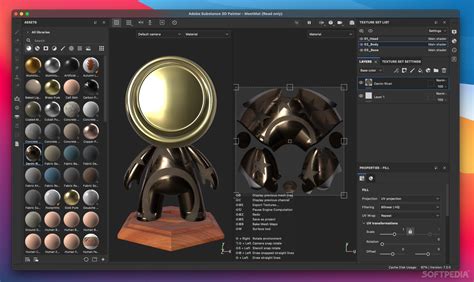
Substance Painter is often described as "Photoshop for 3D models." This analogy highlights its ability to facilitate hand-painted detailing alongside sophisticated procedural effects, such as realistic edge wear. A significant advantage of Substance Painter lies in its function as a universal material editor. It allows artists to craft complex effects that will render identically across various engines, including industry-standard renderers like Octane, Redshift, and real-time engines like Unreal Engine. This universality eliminates the common frustration of differing methods for achieving similar results in different software. The tool automates many of the technical aspects of texture conversion, freeing artists to concentrate on creative expression.
The software's strength lies in its ability to quickly and easily author highly detailed custom materials. This capability significantly enhances the visual fidelity of 3D assets, adding detail and life that might be challenging or cumbersome to achieve with the built-in tools of many other 3D applications. For instance, integrating Substance Painter into a Cinema 4D workflow opens up immense possibilities for material authoring and editing, allowing for a more dynamic and efficient texturing process.
The Substance Painter Master Course: A Project-Based Approach
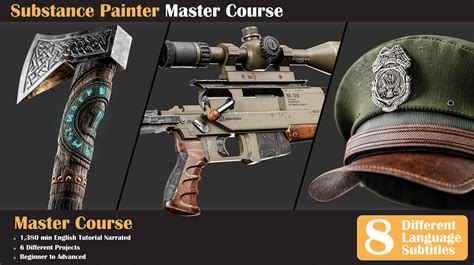
For those looking to achieve mastery in Substance Painter, comprehensive learning resources are available. The ArtStation Substance Painter Master Course, for example, offers a project-based curriculum designed to advance texturing skills. This course, spanning 23 hours of narrated tutorials, is led by an instructor with extensive real-world experience.
The course structure is meticulously designed to guide users through essential workflows, starting with the fundamentals and progressing to advanced techniques. Key modules include:
- Intro & Interface Essentials: Familiarization with Substance Painter's user interface, core tools, viewport navigation, and fundamental workflows.
- Project Setup & Preparation: Understanding how to import models, set up mesh baking, and manage UV layouts effectively.
- Hands-On Projects: A series of practical projects designed to solidify learning. These include:
- Steel Pot: Practicing mesh baking and creating basic Physically Based Rendering (PBR) materials, often presented for high-quality presentation in Marmoset Toolbag.
- Military Hat: Developing materials for leather, metal, and stitched fabric, with the integration of AI-assisted tools like Substance Sampler for material creation.
- Nordic Axe: Building layered wood and metal textures, with a focus on integrating the asset into game engines like Unreal Engine for low-poly workflows.
- Sci-Fi Blade: Exploring advanced techniques such as overlapping UVs, layering decals, and exporting final renders for presentation.
- Air Conditioner: Learning workflows involving Photoshop masking, texture baking processes, and rendering techniques.
- Sniper Gun: Mastering multi-material workflows and transferring outputs to real-time engines like Unreal Engine.
This project-driven approach ensures that learners are not just exposed to concepts but actively apply them to create tangible assets, mirroring real-world production scenarios.
Essential Tools and Software in the Texturing Pipeline
Beyond Substance Painter itself, a robust texturing workflow often involves several other key software packages. These tools complement Substance Painter's capabilities, providing a complete pipeline from asset preparation to final presentation.
- Substance Painter: The primary tool for detailed texture painting and material creation on 3D models.
- Rizom UV Lab: Often used for advanced UV preparation. Proper UV unwrapping is a prerequisite for effective texturing in Substance Painter, ensuring that textures are applied without distortion and that efficient use is made of the UV space.
- Substance Sampler: A powerful tool for creating PBR materials from scanned data or images. It can generate high-quality base materials that can then be further refined in Substance Painter.
- Marmoset Toolbag: Highly regarded for its real-time rendering capabilities, Marmoset Toolbag is frequently used for presenting textured assets with high-quality lighting and rendering. It's also useful for baking mesh maps and presenting final renders.
- Photoshop: Remains a crucial tool for image editing, texture refinement, creating alpha masks, and advanced compositing, often used in conjunction with Substance Painter for specific masking or texture manipulation tasks.
This suite of tools enables artists to manage the entire texturing process, from initial model preparation to final engine integration and presentation.
Skill Level and Prerequisites
Substance Painter is designed to be accessible to a wide range of users, from beginners to advanced professionals. However, a foundational understanding of certain related disciplines significantly enhances the learning experience:
- Basic knowledge of 3D modeling: Understanding how 3D models are constructed and their topology is crucial.
- Familiarity with UV mapping and unwrapping: As mentioned, UVs are fundamental to texturing. Artists should understand how to create clean UV layouts that facilitate efficient texturing. A tutorial on using the newest UV tools in software like Cinema 4D S22, for example, can be beneficial for those new to UV unwrapping.
- Basic knowledge of Photoshop: Proficiency in Photoshop is helpful for texture editing, mask creation, and compositing.
For artists aiming to integrate texturing into production pipelines for games, film, or animation, a comprehensive understanding of the PBR (Physically Based Rendering) workflow is essential. Substance Painter is built around PBR principles, making it an ideal tool for mastering this industry standard.
Core Workflow Takeaways in Substance Painter
Mastering Substance Painter involves understanding and implementing a repeatable texturing pipeline. This typically includes several key stages:
Baking Mesh Maps: This is a critical initial step. Baking generates essential utility maps (like Normal, Ambient Occlusion, Curvature, Position, Thickness) from a high-poly model onto a low-poly mesh, or in some cases, directly from the model itself if no high-poly is available. These maps provide crucial surface information that procedural generators and masks utilize to create realistic effects. For example, Ambient Occlusion can simulate dirt accumulating in crevices, while Curvature can highlight edges for wear effects. When baking within Substance Painter, it's important to ensure the correct settings are applied, such as setting the ID map to "Vertex Color" if vertex colors have been used for material definition. The resolution of these baked maps (e.g., 2K or 4K) also significantly impacts the final detail level.
Bake Normal Maps in Substance Painter! | Optimize High Poly Models
Layered Texturing: Substance Painter's core strength lies in its layer-based system, similar to Photoshop. Artists can stack various fill layers, texture layers, and effects to build up complex materials. This non-destructive workflow allows for easy iteration and modification.
Smart Materials and Masking: Smart materials are pre-made material presets that can be applied to a model and intelligently adapt to its geometry. Masking is equally vital; black masks hide layer properties, allowing artists to selectively reveal effects. Using generators within masks, such as "Metal Edge Wear," leverages the baked mesh maps to procedurally create effects like wear and tear on edges, adding realism.
Exporting Assets: Once texturing is complete, assets need to be exported with the correct texture maps for use in other applications. The export process typically involves selecting a preset tailored to the target engine or renderer (e.g., Metallic Roughness for PBR workflows, or specific presets for Unreal Engine, Unity, or V-Ray). The resolution and format of the exported textures are also important considerations.
Engine Integration: The final stage involves importing the textured assets into a game engine or rendering software. This requires setting up materials within the target application to correctly utilize the exported texture maps (e.g., Base Color, Metallic, Roughness, Normal, AO). Understanding how engines interpret these maps is key to achieving the desired visual outcome.
Practical Workflow Example: Texturing a Model in Cinema 4D and Substance Painter
A common workflow involves preparing a model in a 3D application like Cinema 4D (C4D) before sending it to Substance Painter.
Model Preparation in Cinema 4D
- Single Material Approach: For efficiency, it's often recommended to assign a single material to the object within C4D. This simplifies the process when transferring to Substance Painter.
- Vertex Colors for ID: A powerful technique is to utilize vertex colors within C4D to define different material areas or IDs on the model. By selecting polygons and assigning specific colors (e.g., using the Fill Selection Tool and applying vertex colors), artists can later use these colors within Substance Painter to mask or apply specific materials to those areas. This is achieved by using the Commander (Shift+C) and typing "Vertex" to access vertex color tools. Sampling colors from a reference palette ensures color scheme accuracy.
- Exporting as FBX: Once vertex colors are assigned, the model should be exported as an FBX file. Crucially, the "Vertex Colors" option must be selected in the FBX export settings. This ensures that the color information is preserved and transferred to Substance Painter.
Baking in Substance Painter
Upon opening the FBX file in Substance Painter, it's important to:
- Deactivate Auto-Unwrap: Ensure this option is turned off.
- Set Template: Choose the "Metallic Roughness" template, which is standard for PBR workflows.
- Bake Mesh Maps: Navigate to the "Texture Set Settings" and click "Bake Mesh Maps." Instead of baking from a high-poly mesh (though that's a common use case), select "Vertex Color" under the ID section. This will use the vertex colors exported from C4D to define material IDs. Adjusting the resolution (e.g., to 2K) is also recommended for sufficient detail. These baked maps are essential for procedural generators.
Using Masks and Generators
With the mesh maps baked, artists can begin texturing:
- Applying Base Materials: Drag materials from the Shelf onto the model. If a fill layer with vertex colors was created, ensure that the "Color" channel is deselected on the material layer to preserve the custom colors. This allows the material's properties to be applied while retaining the original color scheme.
- Creating Wear and Tear: To add realism, materials often need to be isolated to specific areas. This is achieved by adding a "Black Mask" to a material layer. Within the mask, a "Generator" can be added. Generators like "Metal Edge Wear" utilize the baked mesh maps (e.g., Curvature) to procedurally apply effects only to edges, creating a worn metal look. Parameters within the generator can be tweaked extensively to achieve the desired result.
Exporting Textures and Building Shaders in C4D
- Exporting Textures: Once texturing is complete, go to "File > Export Textures." Select the desired file destination and ensure the "Texture" setting is "Metallic Roughness" (or a specific preset for engines like Redshift or Octane). This process generates all the necessary texture maps (Base Color, Roughness, Metallic, Normal, etc.).
- Building Shaders in C4D: Back in Cinema 4D, select the material created earlier. In the shader settings (e.g., under Color, Reflectance, or dedicated render engine material channels), load the exported texture maps:
- Base Color: Load the "Base Color" map.
- Roughness: Load the "Roughness" map into the Roughness channel.
- Metallic: Load the "Metallic" map into the Metallic channel.
- Normal Map: Load the "Normal" map into the Normal channel. Ensure the Normal map is set correctly (e.g., DirectX format if required by the engine).
- Displacement: If displacement is desired, load the appropriate height map and enable "Sub Polygon Displacement" in the render settings. It's crucial to start with a low "Height" value to avoid distorting the model.
By correctly applying these textures within C4D's material system, artists can achieve a high level of visual fidelity, with textures transferring accurately from Substance Painter. Adding lighting and an environment in C4D will reveal how well the imported textures translate, often resulting in impressive visual outcomes.
Industry Perspective and Embracing New Tools
On platforms like Reddit, Substance Painter is consistently recognized as an industry-standard texturing tool. Its intuitive layer-based workflows and powerful texture generation capabilities are frequently praised by professionals. While many 3D artists, particularly in motion design, may not have explored Substance Painter, it represents a significant opportunity to enhance render quality and asset detail.
The increasing complexity and demand for realism in games, film, and animation mean that mastering tools like Substance Painter is becoming essential. The ability to create highly detailed, production-ready assets efficiently is a valuable skill. By understanding the fundamental workflowsâfrom baking to layered texturing, exporting, and engine integrationâartists can confidently tackle a wide range of projects across various industries. The comprehensive nature of resources like the ArtStation Master Course, coupled with community insights, provides a solid foundation for artists looking to elevate their 3D texturing capabilities.