The reproductive strategies of oysters are a fascinating departure from the familiar processes seen in many other species, including humans. Birds and bees do it, but how does an animal reproduce when it spends its adult life attached to a hard surface and unable to move? An oyster has no eyes to see its potential mates, nor does it possess a calendar or clock to coordinate a mating time. To make the story even more interesting, Olympia oysters ( Ostrea lurida ), the only oyster native to the West Coast and thus San Francisco Bay, are hermaphrodites, meaning they possess both male and female sex organs. This raises the question: why would an oyster need both sex organs, and how does that help an oyster continue to reproduce generation after generation?
The Alternating Life of an Oyster: A Protandric Existence
Oysters do not have a fixed sex that stays with them throughout the course of their life. Instead, they are protandric, a characteristic that means they can change from male to female over their life. Olympia oysters, for instance, begin their lives as males and sexually mature in about a year. Then, after spawning, the oysters change to female, and this regular alternation of sexes between male and female apparently continues throughout life. This alternating lifestyle is advantageous because at any given time, an oyster should have potential mates nearby. Oysters start off as male and then turn to female for the majority of their lifespan. During an oyster's spawning season, the young male releases his sperm, and older females release their eggs. Sometimes up to hundreds of millions of eggs are released.
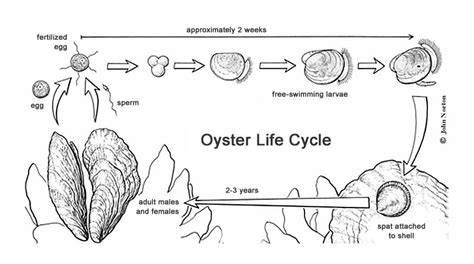
This protandric nature is a key adaptation for a sessile creature. Since oysters are immobile, having the capacity to function as both male and female at different stages of their lives increases the probability of successful reproduction. It ensures that even in a population where individuals cannot seek each other out, there will always be available partners for spawning.
The Spawning Spectacle: A Chemical and Environmental Symphony
The spawning season for oysters typically begins when water temperatures reach about 68 degrees Fahrenheit. However, since oysters are found everywhere from the Chesapeake Bay to Japan's Hokkaido Island, and several different types of oysters exist, spawning dates differ throughout the world. When the waters of the San Francisco Bay estuary warm in the summer, this environmental cue triggers reproductive activity.
During this time, a single oyster can jump-start the spawning process by releasing its sperm into the nearby water. Once it does, surrounding oysters begin to do the same. Male Olympia oysters release sperm balls, and upon contact with seawater, these sperm balls disintegrate, releasing the sperm. A male oyster releases hundreds of thousands of sperm balls, each containing approximately 2,000 sperm. Following the sperm release, older oysters begin to release their eggs into the same water. Sometimes, a single oyster can create hundreds of millions of eggs during one reproductive cycle. The appearance of the oyster will also change during this process. Before spawning, its body is opaque, but during reproduction, it often looks clear or milky and practically translucent. As long as an oyster has been handled and refrigerated properly, it won't hurt you to eat an oyster that is going through the spawning process.
It's Oyster Spawning Season
The Eastern oyster (Crassostrea virginica) offers another example of this synchronized release. Spawning for this species typically occurs from late June to November, with a peak in June and July. This timing is not arbitrary; it is believed to coincide with periods when their food, algae, is likely to be most abundant. This ensures that the developing larvae have the best chance of survival. The life of an Eastern oyster, like that of a human, begins when an egg is fertilized by a sperm. This happens typically on an oyster reef when males and females-otherwise identical in outer morphology-respond to environmental cues of temperature and salinity that cause them to start reproducing. Once the first male releases sperm, it causes other males to follow suit, simultaneously triggering females to cast millions of eggs into the water column, all coming together to form a milky cloud rising away from the reef.
From Fertilized Egg to Planktonic Larva: A Drifting Existence
The fertilized eggs develop inside the female for about 10 days before being released into the environment. While not yet visible to the naked eye, the planktonic fertilized egg drifts in the water column, rapidly dividing to become a multi-cellular, free-swimming larva. This larval stage is crucial for dispersal. The larvae then become part of the planktonic community, floating with the currents and tides. They continue cell division through several larval stages.
The development of larvae takes about six hours to develop into a form that can be fertilized, and then a few weeks to settle into another oyster shell or rocky place. During this planktonic phase, the developing oyster is vulnerable to a myriad of environmental factors, and only a fraction will survive to the next stage.
Settling Down: The Journey to Becoming Spat
After approximately three to four weeks, the larvae metamorphose to their juvenile form and are ready to settle on and attach to a hard substrate. This substrate can be oyster reef balls, rip rap along the shoreline, or scientific monitoring devices. The larvae eventually develop a foot that precipitates their drop to the seafloor, where they crawl along the bottom searching for suitable hard substrate on which to settle.
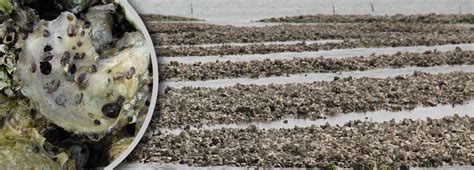
When the sought-after substrate is encountered, they attach to it with a glue-like substance and metamorphose into a spat. A spat (so called because "spawning" is considered reminiscent of "spitting") is a young oyster that is attached, or sessile, and starts forming a shell. If the oysters are able to find a hard substrate, which can be difficult and thus the reason for native oyster restoration efforts, they attach themselves and will hopefully remain there to live out their lives.
Survival and Maturation: The Path to the Next Generation
If the attached baby oyster, or “spat,” can survive a number of factors-including predation, low salinity, exposure during high temperatures, and sedimentation-then the oyster should be able to produce the next generation of native oysters in the Bay who will also participate in the odd and unique sexual life of oysters! The oyster typically grows at a rate of about an inch a year, reaching sexual maturity somewhere between one and three years of age. Spawning takes a lot of energy out of the animals, but for many types of oysters, it's the last work they have to do as parents until the process starts again the next year.
The internal anatomy of an oyster is simple in appearance yet functions in a remarkable, highly specialized fashion. It allows them to extract oxygen and tiny food particles from water passing over their gills and the mantle (tissue surrounding the entire body that produces the oyster shells). Food particles are bound in mucus and moved by cilia covering the gills towards the hinge and into the mouth, and from there to the stomach. Once nutrients are removed, the remaining material passes out the anus into the body cavity as feces. Particles not considered edible (e.g., sand, detritus, or food particles too big to eat) never enter the digestive tract. These "pseudofeces" are bound in mucus, accumulate in the mantle cavity, and are periodically forcibly ejected from the mantle cavity with actual feces, sinking to the sea floor as 'biodeposits'. Oyster deposition of feces and pseudofeces on the bottom can benefit estuarine systems, often plagued by eutrophication, by reducing available nitrogen in the water column.