In the realm of audio creation, the pursuit of pristine sound is paramount. Whether you're a podcaster aiming for crystal-clear dialogue, a musician seeking to isolate vocal performances, a journalist refining interview recordings, or a content creator striving to avoid copyright infringement, the presence of unwanted background music can be a significant impediment. Fortunately, the advent of advanced AI-powered tools has revolutionized the process of extracting vocals and eliminating extraneous audio elements, making previously complex and time-consuming tasks remarkably simple and accessible. This article delves into the intricacies of removing background music from audio, exploring the underlying technologies, practical applications, and the user-friendly solutions available today.
The Challenge of Background Noise and Music
Historically, removing background music from an audio recording was a labor-intensive endeavor, often requiring specialized software and a deep understanding of audio engineering principles. Creators would grapple with intricate equalization settings, noise reduction filters, and manual editing techniques, all of which demanded considerable time and expertise. For individuals with no prior experience in audio editing, such as those looking to isolate vocals from a personal music project or clean up a recorded song, these methods were often prohibitive. The desire to "just hear the vocals" or obtain an "acapella version" was frequently met with complex explanations and a steep learning curve.

The core of the problem lies in the way audio is recorded and mixed. In many recordings, vocals and background music are blended together into a single audio track. Separating these distinct elements without degrading the quality of the desired component (usually the vocals) is technically challenging. Traditional methods often relied on broad filtering techniques that could inadvertently remove parts of the vocals or other essential audio information, leading to a “hollow” or unnatural sound. This was a significant hurdle for anyone who needed to remove background music from a song or video but lacked the technical acumen to do so effectively.
AI-Powered Solutions: A Paradigm Shift
The emergence of Artificial Intelligence, particularly in the domain of deep learning and source separation, has fundamentally changed how we approach audio manipulation. AI-powered tools, such as online services designed for noise reduction and background music removal, employ sophisticated algorithms that can intelligently analyze and distinguish between different sonic elements within an audio file.
These advanced algorithms are trained on vast datasets of audio, enabling them to recognize the unique characteristics of vocals, instruments, and ambient noise. Unlike older filtering methods that applied generic adjustments, AI can pinpoint and isolate specific components with remarkable accuracy. This means that unwanted background music can be effectively cancelled out, leaving behind a clean, clear vocal track with minimal loss of quality. The process is no longer about crude filtering but about intelligent deconstruction and reconstruction of the audio signal.
How AI Background Music Removers Work
The process of removing background music using AI is typically streamlined into a few simple steps, making it accessible even to novice users:
Upload Your Audio File: Users can easily upload their audio or video files directly to the online platform. These services generally support a wide range of popular formats, including MP3, WAV, AAC, MP4, and more, ensuring compatibility with most recording and project needs. This eliminates the need for complex file conversions or software installations.
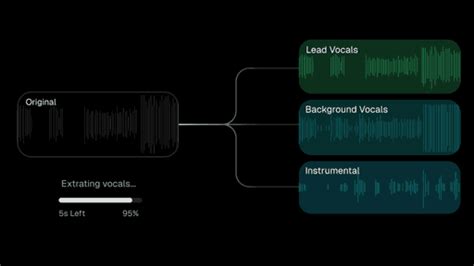
AI Processing: Once uploaded, the AI engine takes over. It automatically analyzes the audio, identifying and separating the vocal components from the background music and other non-vocal sounds. This is where the deep learning models come into play, meticulously dissecting the sonic layers.
Preview and Refine (Optional): Many services offer a preview of the processed audio, allowing users to hear the result before committing to a full download. Some advanced tools also provide options to adjust parameters like "Noise Canceling Level," enabling users to fine-tune the separation process if the initial results require minor adjustments. This feature is particularly useful for complex audio environments where subtle nuances might need attention.
Download Clean Audio: After processing, users can download the isolated vocal track, now free from distracting background music. The output is typically a high-quality audio file, ready for use in various applications.
This intuitive workflow bypasses the need for learning complex audio editing software, saving users significant time and effort. The efficiency gains can be substantial, often exceeding 5x compared to traditional manual editing methods.
Key Features and Benefits of AI Music Removers
The effectiveness and popularity of AI-powered background music removers stem from a combination of advanced technology and user-centric design. Several key features distinguish these tools and offer significant advantages:
Crystal-Clear Voice Isolation
At the forefront of these tools is their ability to isolate vocals with exceptional accuracy, often cited as up to 98%. This precision ensures that the desired voice clarity is maintained, even in recordings with complex sonic landscapes. The AI's deep understanding of audio signals allows it to differentiate between vocals and instruments with a level of detail that traditional methods simply cannot match. This capability is crucial for ensuring that the extracted voice is not only free from music but also retains its natural quality and intelligibility.
Speed and Efficiency
One of the most significant benefits is the speed at which these tools operate. By eliminating the need for manual editing and complex software, AI background music removers can process audio files in seconds or minutes, rather than hours. This rapid processing not only saves time but also boosts overall workflow efficiency, allowing creators to produce polished audio content much faster. The "fast queue" options available on some platforms further accelerate the process for users with urgent needs.
Wide Format Compatibility
The ability to handle a diverse range of audio and video file formats is a critical advantage. Services that support common formats like MP3, WAV, AAC, M4A, MP4, and MKV cater to a broad spectrum of users, from podcasters working with audio files to video editors dealing with multimedia content. This flexibility ensures that users can upload their files without the hassle of format conversion.
AI-Powered Audio Separation
The underlying technology is a major differentiator. Instead of relying on outdated filtering techniques, these tools leverage advanced machine learning models. These models are designed to intelligently detect and separate vocals, instruments, and background layers with studio-grade precision. This sophisticated approach ensures that the separation is clean and the quality of the extracted audio is superior.
Security and Privacy
For many users, especially professionals handling sensitive recordings, privacy is a major concern. Reputable online services address this by employing secure cloud processing and automatically deleting uploaded files within a specified timeframe (e.g., 24 hours). This ensures that user data remains private and protected.
Free Trials and Flexible Plans
To make these powerful tools accessible, many providers offer free trials, allowing users to experience the benefits without immediate commitment. Beyond the trial, flexible pricing plans are available, catering to individuals, small creators, and larger teams. These plans often vary based on processing minutes, queue priority, and file size limits, providing options for different usage needs and budgets.
How to REMOVE Background Music (the good way) | Free & no daily limits
Popular Use Cases for Background Music Removal
The applications for AI-powered background music removal are vast and varied, touching numerous fields and creative endeavors:
Podcasting and Voice-Over Production
Podcasters and voice-over artists frequently require pristine vocal tracks devoid of any distractions. Whether it's an interview with background ambiance or a scripted narration inadvertently overlaid with music, these tools enable creators to isolate the spoken word, ensuring a professional and polished final product. This is crucial for maintaining listener engagement and delivering a clear message.
Audiobook and Speech Recording
When producing audiobooks, speeches, or educational content, background sounds can significantly detract from the listener's experience. Using AI to remove background music from audio ensures that the narrator's voice remains the primary focus, making the content easier to follow and more professional. This is particularly important for long-form content where listener fatigue can be a factor.
Music Remixing and Sampling
For musicians, DJs, and producers, these tools are invaluable for creative manipulation. They allow for the isolation of vocals to create acapella versions for remixes, or the extraction of instrumental tracks for practice, karaoke, or creating new musical pieces. This capability opens up a world of creative possibilities for sampling and reimagining existing music.
Journalists and Transcribers
Journalists often deal with audio recordings of interviews or events that may contain background noise or music. Cleaning up these recordings enhances voice clarity, making speech-to-text transcription faster and more accurate. Transcribers benefit greatly from clear, isolated dialogue, reducing the effort required to decipher spoken words.
Musicians and Vocalists
Musicians recording vocals in a home studio can face challenges with microphone bleed and ambient noise. While AI might not replace professional studio setups, it can assist in reducing unwanted background elements from vocal recordings, providing a cleaner track for further mixing or demonstration purposes. It can also be used to isolate instrumental parts for practice.
Content Creators and Video Editors
For video creators, copyright issues related to background music are a constant concern. Using an AI tool to remove copyrighted music from video soundtracks allows creators to replace it with royalty-free music or to create videos that focus solely on dialogue and sound effects, thus avoiding potential legal complications and demonetization issues.
Addressing Common Concerns and Misconceptions
While the technology is advanced, some users may have specific questions or misconceptions about the process.
Removing Background Music Only vs. Other Sounds
A common query is how to remove background music only while preserving other elements like sound effects (SFX) or ambient noise. Modern AI tools are designed to be highly specific. They can often differentiate between music, speech, and other environmental sounds. Services like LALAL.AI Voice Cleaner are explicitly designed to remove background music while maintaining vocals and sound effects, ensuring that key audio elements remain untouched. The goal is to isolate the desired audio component, whether it's vocals, instruments, or dialogue, from the unwanted musical elements.
Preserving Vocal Quality
A critical concern is whether removing background music will degrade the quality of the vocals. Basic, older tools might indeed produce robotic or muffled vocals. However, state-of-the-art AI vocal separators, built on advanced machine learning, are engineered to minimize quality loss. They analyze the audio spectrum with great precision, ensuring that the separation is clean and the resulting vocal track is as natural and high-fidelity as possible. This is often referred to as "voice isolation," an advanced AI process that specifically identifies and extracts vocal tracks.
Handling Old or Complex Recordings
Users often wonder about the effectiveness of these tools on older recordings or audio with particularly complex mixes. Many AI music background removers have demonstrated a surprising ability to handle degraded audio. By intelligently analyzing sonic details, they can often extract clear vocals even from recordings where background noise is significant or where the music is densely layered. The "Noise Canceling Level" adjustment in some tools provides an extra layer of control for tackling these challenging scenarios.
Free vs. Paid Solutions
While free trials and basic free tiers are common, advanced features, higher processing limits, and faster queue times are often part of paid plans. For users with frequent or intensive needs, investing in a paid plan can be cost-effective, offering greater control, higher quality outputs, and more efficient processing. However, for occasional use or for testing the technology, free options provide excellent accessibility.
The Future of Audio Separation
The continuous advancement of AI technology promises even more sophisticated audio separation capabilities in the future. We can expect tools that offer even finer control over individual instrument isolation, better handling of complex polyphonic music, and perhaps even the ability to manipulate or enhance specific aspects of a vocal performance. As AI models become more refined and processing power increases, the line between human-engineered audio and AI-assisted audio will continue to blur, empowering creators with unprecedented tools for sonic manipulation and refinement. For anyone looking to achieve crystal-clear audio without the headache of complex editing, AI-powered background music removal represents a powerful and accessible solution.