The escalating urgency of climate change, coupled with the ambitious targets set by international agreements like the Paris Agreement, has propelled the development and deployment of innovative carbon capture technologies to the forefront of global environmental strategies. Among these, Direct Air Capture (DAC) stands out as a pivotal technology, offering a direct pathway to remove existing carbon dioxide (CO2) from the atmosphere. This article delves into the intricacies of DAC, its significance in achieving net-zero goals, and the burgeoning landscape of its implementation, particularly focusing on the initiatives and partnerships shaping its future.
Understanding Direct Air Capture (DAC)
Direct Air Capture, as defined by the International Energy Agency (IEA), is a process that extracts CO2 directly from ambient air. This is a critical distinction from point-source carbon capture, which targets CO2 emissions at their origin, such as industrial smokestacks. DAC technology offers a unique advantage by addressing CO2 emissions from dispersed sources, which are often difficult to tackle. These dispersed sources include emissions from automobile and airplane travel, as well as diffuse industrial activities.
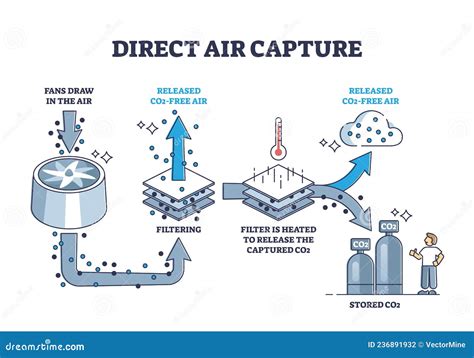
The fundamental mechanism of DAC involves drawing air into a processing facility using high-powered fans. Once inside, the CO2 is separated from the air through a series of chemical reactions. A significant differentiator in DAC processes is the sorbent used. Carbon Engineering's DAC process, for instance, utilizes a liquid sorbent rather than a solid one. This liquid sorbent is then processed, often using high temperatures, to release the captured CO2.
The captured CO2 can then be utilized in various ways or permanently removed from the atmosphere. One primary method of permanent removal is geologic sequestration, which involves storing the CO2 in geological formations deep underground. Alternatively, captured CO2 can be used as a raw material for various industrial applications, including the creation of low-carbon products such as plastics and concrete, or even synthesized into clean transportation fuels.
The Imperative for CO2 Removal
The Intergovernmental Panel on Climate Change (IPCC), in its 2018 report, highlighted that achieving the Paris Agreement's goal of limiting global temperature rise to 1.5 degrees Celsius necessitates not only significant emissions reductions but also the removal of atmospheric CO2. Models published by both the IPCC and the IEA suggest that removing up to 20 gigatons (Gt) of carbon dioxide per year from the atmosphere will be required. This underscores the critical role of carbon removal technologies, with DAC listed by the IEA as a key option in the transition to a net-zero energy system.
The development of large-scale DAC is considered one of the most important technologies that will help organizations and society achieve their net-zero goals. It provides a practical, transparent, and durable carbon removal solution, aligning with the sustainability strategies of many corporations. The potential for DAC is substantial; while currently, only 27 DAC plants are operational globally, capturing approximately 0.01 million tonnes of CO2 per year, projections indicate that if all proposed facilities move ahead, DAC could capture 65 million tonnes annually by 2030. This figure is approaching the level needed under the Net Zero Emissions by 2050 scenario.
Key Players and Projects in DAC Development
Several companies and organizations are at the forefront of developing and deploying DAC technology. 1PointFive, a company formed as a partnership between Occidental (Oxy) Low Carbon Ventures and Rusheen Capital Management, is a prominent entity in this space. 1PointFive's mission is to reduce the amount of carbon dioxide in the atmosphere using Carbon Engineering's DAC technology.
The STRATOS Facility and South Texas DAC Hub
1PointFive is currently developing its South Texas DAC Hub, located on the King Ranch in Kleberg County, Texas. This hub will host a DAC facility with an initial annual removal capacity of 500,000 metric tons of CO2, with plans to expand in the future to over 1 million tons per year. Under a funding agreement, 1PointFive was awarded an initial $50 million to advance its work at the South Texas DAC hub, with up to $600 million to be awarded for the initial DAC facility at the site.
A cornerstone of 1PointFive's operations is the STRATOS facility, its first large-scale Direct Air Capture facility, which is designed to extract carbon dioxide from ambient air directly. STRATOS is being built in West Texas, with Occidental already involved in its development. This facility is expected to capture up to one million metric tons of atmospheric CO2 annually once operational. The project is planned at King Ranch in Kleberg County, a site strategically located near Gulf Coast industrial zones and energy infrastructure.
Partnerships and Agreements
The commercialization and scaling of DAC technology are being driven by significant partnerships and agreements.
Enterprise Products Partners L.P.: 1PointFive and Enterprise Products Partners L.P. have announced an agreement for the development of a CO2 transportation network to support the Bluebonnet Sequestration Hub that 1PointFive is developing in southeast Texas. Under this agreement, Enterprise will develop a new pipeline network and provide fee-based transportation services to move CO2 emissions captured by third parties at facilities near the Houston Ship Channel to 1PointFive’s sequestration hub. This collaboration aims to provide a reliable and efficient way for hard-to-abate sectors to address their CO2 emissions.
Rockwell Automation: Rockwell Automation has entered into an agreement with 1PointFive to purchase carbon dioxide removal (CDR) credits from its Direct Air Capture (DAC) facility under construction in Texas. This partnership aligns with Rockwell Automation's commitment to achieving its goal of net-zero, carbon neutrality by 2030. Rockwell Automation believes that Direct Air Capture technology is a vital part of the solution for achieving net-zero goals, emphasizing its scalability as a key differentiator.
JPMorgan Chase: In June 2025, 1PointFive announced that JPMorgan Chase purchased 50,000 metric tons of carbon dioxide removal (CDR) credits over 10 years, enabled by Direct Air Capture (DAC). These CDR credits will be produced from STRATOS, 1PointFive’s first DAC facility in Texas. This agreement is part of JPMorgan Chase's strategy to address operational emissions and helps establish a market for high-quality and durable carbon removal credits.
ADNOC's XRG: Occidental and ADNOC's energy investment company, XRG, have partnered to build a large Direct Air Capture (DAC) facility in South Texas. XRG is considering an investment of up to $500 million to support the project. This potential joint venture exemplifies the fight against climate change using carbon capture technology.
Why carbon capture needs a reality check
The Science and Engineering Behind DAC
The operation of Direct Air Capture facilities requires significant power. Mission-critical equipment within the facility is used to move, process, and separate large volumes of CO2 from captured air. Therefore, the power strategy for DAC facilities is crucial. The STRATOS facility, for example, is designed to achieve net-zero power emissions through a combination of on-site power and off-site renewable-specified power from the grid. This power will be sourced from additional capacity for renewable electricity. While renewable energy sources are prioritized, facilities like STRATOS will also use natural gas to achieve the high temperatures needed in the calciner, a component used in the process of releasing CO2 from the sorbent.
The scalability of DAC technology is a key differentiator. 1PointFive is currently building what is intended to be the world's largest DAC facility, with plans for its next generation of DAC facilities to potentially double in capacity. This ambition is supported by the fact that Occidental has over 40 years of experience in carbon dioxide management, applying its technical ingenuity and engineering skill to make large-scale DAC facilities a reality.
Carbon Engineering's Role
Carbon Engineering (CE) is a foundational technology provider in the DAC space. Founded in 2009, CE is a Canadian-based clean energy company focused on the deployment of DAC technology. From a pilot plant in Squamish, British Columbia, CE has been removing CO2 from the atmosphere since 2015. Their business model involves licensing their technology to developers worldwide to enable rapid and widespread global deployment of DAC technology. This licensing approach is seen as a critical next step in the commercialization of DAC technology, aiming to prove the technology at a large, climate-relevant scale, validate its cost, and demonstrate that DAC is a feasible, available, and affordable tool.
Sequestration and Utilization
The captured CO2 from DAC facilities can be permanently stored or utilized. Occidental, with its extensive experience in CO2 management, plays a crucial role in the permanent, safe, and secure underground storage of captured CO2 in geological formations. This can be for direct use in lower-carbon oil production, which permanently stores CO2 as part of the process, or for geologic sequestration to deliver permanent carbon removal. This is vital for counteracting hard-to-eliminate emissions and helping businesses achieve their net-zero targets.
Furthermore, the utilization of captured CO2 as a feedstock for low-carbon products like plastics and concrete, or for creating clean transportation fuels (as demonstrated by Carbon Engineering's AIR TO FUELS solution), adds economic value and further incentivizes the deployment of DAC technology.
Challenges and Future Outlook
Despite the significant progress, challenges remain in the widespread adoption and scaling of DAC technology. These include the need for continued market incentives, access to capital, and the ability to develop and employ existing or new technology on a commercial scale. Regulatory approvals, market conditions, geopolitical events, and scientific developments also play a role.
However, the outlook for DAC is promising. The global market for carbon capture and removal is projected to reach $100 billion by 2030, according to BloombergNEF. The significant investment by the United States in Direct Air Capture technology, coupled with international collaborations and the increasing demand from corporations for durable carbon removal solutions, signals a strong trajectory for the growth of the DAC industry. The development of robust monitoring, reporting, and verification plans by regulatory bodies like the Environmental Protection Agency is essential to validate the integrity, transparency, and permanence of the entire sequestration process.
The aspiration to limit global temperature rise to 1.5 degrees Celsius, as outlined in the Paris Agreement, is a powerful driver for innovation in carbon capture. DAC technology, with its potential to remove billions of tons of CO2 from the atmosphere, is poised to be a key component in achieving this critical climate goal, while also promising significant economic benefits through the development of new industries and job creation.