Adobe Photoshop has long been the undisputed king of photo editing, setting the industry standard for professional tools and effects. For those seeking powerful alternatives, especially those looking to move beyond subscription models or find solutions tailored to specific needs, a rich ecosystem of software has emerged. This article delves into the most compelling Photoshop CS5 alternatives, with a particular focus on replicating the functionality and workflow of its esteemed Camera Raw filter. Whether you are a seasoned professional photographer, a digital artist, or a hobbyist looking to refine your images, these alternatives offer robust feature sets designed to meet a wide array of editing demands, from intricate color correction to broad image manipulation.
Serif Affinity Photo: The Closest Competitor
When testing the best alternatives to Photoshop, professional tools and effects that compare well with Adobe's premiere photo editing suite are paramount. For many, Serif Affinity Photo stands out as being as close as you can get in terms of features and workflow. In our tests, we found this a highly capable app that easily matches almost everything you can do in Photoshop. Better yet, it's available on Windows, macOS, and iPad for a one-off cost, making it a stellar choice for those looking to avoid ongoing subscriptions.
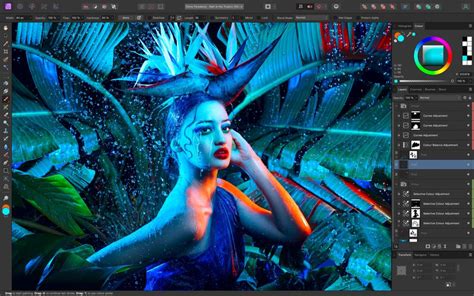
Affinity Photo is positively packed with professional tools that make it a genuine rival to Photoshop for both Windows and macOS. There’s also a tablet version if you're looking for one of the best Photoshop alternatives on iPad. During our testing, we found an impressively clean interface, although the UI can be occasionally glitchy. There’s also no shortage of useful tools, including PSD file support, RAW Support, masking, layering, retouching, removing blemishes, curving, and a full set of 16-bit filters. In fact, the amount of tools available is impressively large, capably rivalling the professional feature-set of Photoshop. Just don't let yourself get too overwhelmed with the power on offer. Best of all, there are no endless subscriptions, just a one-off cost, making it ideal when working to a budget - one of the main reasons why we like this software so much. The app is available as a standalone download.
GIMP: The Open-Source Powerhouse
GIMP (GNU Image Manipulation Program) is a professional, open-source photography powerhouse that works on Linux, Windows, and macOS. So, it's both an excellent Adobe Photoshop alternative overall and an excellent free alternative, too. In our review, we championed the fact that GIMP comes with an absolutely huge range of pro-grade tools for editing images, drawing, and more. If you're familiar with Photoshop already, it won't take too long to get to grips with the interface. And if you're new to all this, you'll find a huge community of developers and artists who have created a wide array of plugins, making this a highly adaptable program. If you desire a specific feature, there’s probably an add-on for it. The interface is highly customizable, so you can pare things back or leverage multiple windows and toolbars as needed.
One user, seeking to replace their Adobe subscription, noted that GIMP is a natural choice for bitmap editing. They are also looking for something to recreate Bridge's ability to browse raw files, a feature often associated with Adobe Camera Raw. While GIMP itself is primarily an editor, the broader open-source ecosystem offers solutions for raw file browsing and pre-processing.
9 Photo Editing Skills Every GIMP User Should Know (Beginner Friendly)
Pixlr: Browser-Based Editing Convenience
Pixlr is one of the best free Photoshop alternatives online, and what makes this a good pick is that it's available as a web app. During our review of the HTML5 photo editing software, we found it to be impressively feature-rich compared to downloadable software. Often, this tool and Pixlr Editor are used for quick image edits and compositions when there's no need to crack open Photoshop. The interface is more spartan than either Photoshop or GIMP, but that’s not a bad thing. The workflow is streamlined and intuitive: you can drag-and-drop a photo from your computer or add a URL, and then get to work adjusting images with familiar one-click filters and sliders.
Given that it’s a web app, Pixlr has surprisingly robust layer support, one of the reasons why it's considered one of the best Photoshop alternatives. However, important features are still missing. Custom brushes, for example, are slated for development in the future but don’t exist yet. Overall, Pixlr gives you a super clean and intuitive interface for basic to medium-complexity photo editing.
ACDSee Photo Studio Ultimate: The Intermediate's Choice
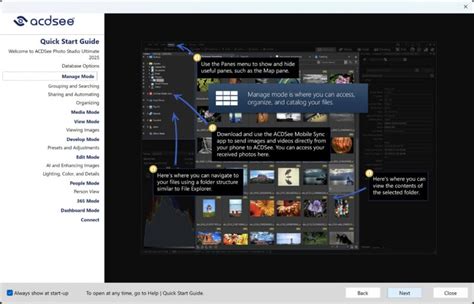
ACDSee Photo Studio Ultimate is an image manipulation tool that, like any good Photoshop alternative, allows you to perform many of the functions you’d find in Adobe's popular photo editor, but at a fraction of the cost. We found this app to be an ideal middle-ground if you're not quite a beginner, but not yet a pro. When we tested out the software, we found a versatile alternative to Photoshop. It might not match every powerful feature in Adobe’s top tool, but it delivers most tools for most photographers and designers, including layers and RAW file editing. As expected, there are AI tools on offer here, too. For us, this is an ideal Photoshop alternative for intermediates, rather than full professionals. What's especially appealing here is the option to buy a perpetual license - great for those wanting to avoid Adobe subscriptions (or any other subscriptions for that matter). But you can still get it for a monthly or annual fee, if you prefer, with a range of cloud storage options depending on how much you pay. Overall, it's one of the best Photoshop alternatives for creating professional-looking content while working to a budget.
Luminar Neo: AI-Powered Photography Enhancements
Photoshop is loaded with AI tools, so a good alternative should also boast at least some of these features. And that's precisely what Luminar Neo offers. This app features a wealth of industry-standard AI tools that should make design and content creation so much easier (and, presumably, faster). This includes tweaking curves, white balance, a cropping tool, and Luminar's much-vaunted sky replacement tool. In our tests, these worked very well, overall. Aside from a couple of hitches, we were left generally rather impressed with the results. So, who's it good for? Our sense having reviewed the software is that this is the ideal tool for amateur photographers. Unfortunately, for professional use, it's missing certain features and performance, as with its simpler sister software Luminar AI, can be occasionally spotty.
Photo Pos Pro: Versatility for Teams and Businesses
We're ranking Photo Pos Pro as one of the best Photoshop alternatives, particularly for small teams and businesses, because it's just so feature-rich. Photo Pos Pro comes with tools for editing images, web design, and document creation. Pretty much any design work you need can be handled here. Better still, it has a twin-track interface: one for beginners, one for experts. This customizable interface lets you select either Novice or Pro layouts. Both have their advantages and disadvantages, but essentially, the novice layout sacrifices power for usability, while the pro layout is feature-rich, albeit with a steep learning curve. Even if it’s not executed perfectly, this flexibility is commendable and practical. While it lacks the deep customization that professional photographers rely on, it's still one of the best Adobe Photoshop alternatives for making adjustments to photos for presentations and marketing campaigns.
Krita: A Digital Painting and Drawing Gem
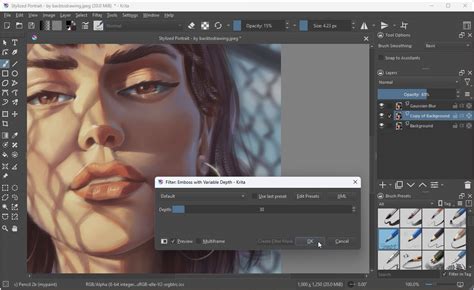
Krita is open-source and a free alternative to Adobe Photoshop, backed by a huge community of developers and talented artists who share artwork and methods. If you’re looking for an active user base that’s invested in discussing and sharing art, Krita is a great Photoshop alternative for drawing. Beyond the community, Krita is incredibly powerful photo editing software, with hundreds of brushes and a brush customization engine, vector and text capabilities for comic strips, a wrap-around mode for seamless repeating images and patterns, and a powerful resource manager for importing tools from other artists. We found the interface intuitive and familiar, with minor functions like being able to scroll sliders with the trackpad and having helpful tooltips that let us know to find the right tool. Krita isn't one of the best Adobe Photoshop alternatives for its photo editing tools. In fact, it's more of a drawing tool than a photo editor. For that reason, certain features are missing: fewer photo filters, no automatic heal tool, etc.
Addressing Raw File Browsing and Pre-processing Needs
The user experience with Adobe Bridge and Camera Raw highlights a common need: efficient browsing and initial processing of raw files before deeper editing. For those migrating from Adobe's ecosystem, replicating this workflow is crucial. While GIMP excels at bitmap editing, the need for a dedicated raw browser and processor is apparent.
RawTherapee emerged as a strong contender for raw file conversion and pre-editing. It offers robust tools for adjusting parameters before exporting to formats like JPG or DNG. However, it has been noted that RawTherapee, while capable of displaying thumbnails and allowing navigation through folders, does not inherently catalog images in the way a dedicated browser might. This means users rely on their file folder system for organization. Furthermore, some users have encountered issues with specific camera raw formats, particularly on macOS, though Windows versions generally offer broader compatibility.
Darktable is another open-source raw processor that has been mentioned. While one user found it "not their cup of tea" years ago, newer versions may offer a more refined experience. The key differentiator for raw browsing is often the ability to quickly preview images at a larger size and access metadata without fully loading them into an editor. Applications like Adobe Bridge offer this out-of-the-box, and while RawTherapee can display thumbnails, it doesn't fully replace the immediate visual browsing experience of a dedicated file browser.
A user looking for a direct replacement for Adobe Camera Raw (ACR) for Windows 11, specifically for editing photos with brushing adjustments and final sharpening with Topaz, without working with layers, has received several recommendations. These include PhotoScape X (free with a Pro version), DxO PhotoLab 5 Elite (perpetual license, known for its noise reduction and Nik U-point technology), and ACDSee Photo Studio Professional (avoiding complex bit-mapped editors). These options aim to provide a streamlined editing experience akin to ACR's core functionality.
Advanced Color Correction and Local Adjustments
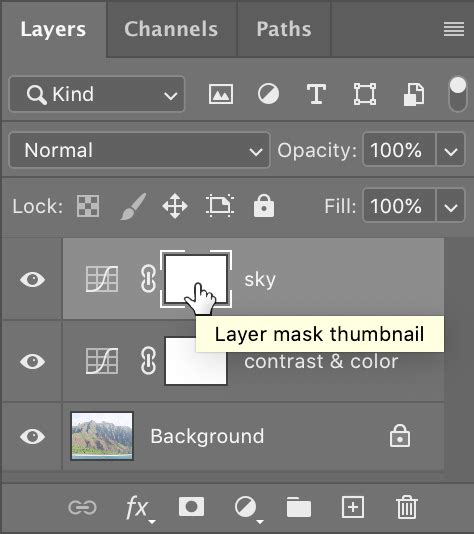
For users with highly specific color correction needs, such as matching scanned artwork to originals, the limitations of some alternatives become apparent. While Photoshop CS5 offers extensive layer-based adjustments, the process can become tedious when numerous layers and masks are required for fine-tuning. Camera Raw, though offering specific color range choices, can be less adept at intricate local adjustments without the benefit of layers.
Capture One has been suggested as a potential solution for these advanced color correction tasks. Its ability to handle local adjustments with precision, potentially surpassing Camera Raw in this regard, makes it a compelling option for those prioritizing accuracy over aesthetic enhancement. The desire is not to make images more appealing, but more accurate to the original. This level of control is critical for reproducing the nuances of artwork.
The challenge of making subtle exposure modulations, for instance, on a white dress with internal shadows, highlights the difficulties encountered when a direct Camera Raw filter application is too taxing for the system. Using adjustment layers with masking can be an alternative, but achieving fine enough control over localized shadows without affecting surrounding areas can be problematic. Techniques like using the "color range" selection to isolate specific areas for targeted adjustments with curves or hue/saturation can offer more granular control, preventing unintended shifts in other pixels. This approach allows for subtle color shifts and exposure modifications at a pixel level, providing a more accurate and controlled editing process.
When evaluating Photoshop CS5 alternatives, particularly for the functionality of its Camera Raw filter, it's essential to consider the specific demands of your workflow. For broad editing capabilities and a subscription-free experience, Affinity Photo is a leading contender. For a free and open-source solution with extensive features, GIMP is unparalleled. For browser-based convenience, Pixlr offers a streamlined experience. Intermediates may find ACDSee Photo Studio Ultimate to be an ideal balance of power and cost. Luminar Neo leverages AI for impressive enhancements, while Photo Pos Pro provides versatility for business needs, and Krita excels in digital painting. For those focused on raw file management and pre-processing, RawTherapee and Darktable, within the broader open-source ecosystem, offer valuable tools, though they may not fully replicate the seamless browsing experience of Adobe Bridge. Ultimately, the best alternative will depend on your individual requirements for features, budget, and workflow integration.