Adobe Photoshop, a name synonymous with digital image manipulation, stands as a titan in the creative software industry. Its journey from a humble garage project to an indispensable tool for professionals and enthusiasts alike is a testament to innovation, strategic foresight, and a deep understanding of evolving technological landscapes. Understanding who owns Photoshop requires tracing the lineage of its development back to its creators and the company that brought it to the global stage: Adobe Systems Incorporated.
The Architects of Pixels: John Warnock and Charles Geschke
The story of Adobe, and by extension Photoshop, begins with two visionary computer scientists, John Warnock and Charles Geschke. While working at the renowned Xerox Corporation's Palo Alto Research Center (PARC), they developed a groundbreaking page description language (PDL) called InterPress. This language was designed to translate the complex instructions for text, graphics, and page layout into a format that printers could universally understand, regardless of the specific device. This was a crucial innovation in an era where printing and digital document handling were plagued by incompatibility and inconsistency.
Frustrated by Xerox's perceived slowness in commercializing InterPress, Warnock and Geschke, along with a venture capitalist's backing, decided to forge their own path. In December 1982, they founded Adobe Systems Incorporated, named after the Adobe Creek that flowed behind Warnock's Los Altos, California home. Their initial vision was to revolutionize how digital documents and graphics were created, displayed, and shared, a mission that would profoundly shape the digital world.

PostScript: The Foundation Stone
Adobe's first major product, PostScript, was a specialized printing software that quickly became an international standard. It provided a universal language for describing fonts and graphics, ensuring that documents would render consistently across different printers and resolutions. This innovation was particularly appealing to burgeoning companies like Apple, which was focused on user-friendly computing and high-quality output.
Steve Jobs, recognizing the immense potential of PostScript, famously offered to buy Adobe outright for $5 million shortly after its inception. The founders, however, declined the acquisition but agreed to sell 19% of their company's shares to Apple for a significant premium, along with a five-year advance license fee for PostScript. This strategic partnership not only provided Adobe with crucial capital but also lent immense credibility to their nascent technology. The deal was so advantageous that Adobe became the first company in Silicon Valley to achieve profitability in its first year of operation.
The integration of PostScript into Apple's LaserWriter printer in 1985, alongside Aldus PageMaker, essentially birthed the desktop publishing revolution. This ecosystem empowered individuals and small businesses to produce professional-quality printed materials, marking a significant shift in the industry and solidifying Adobe's position as a key player.
The Birth of an Icon: The Knoll Brothers and Photoshop
While Adobe was establishing its dominance in the printing and publishing software market with PostScript and later Illustrator (developed in 1987, partly inspired by Warnock's wife, Marva, a graphic designer), another pivotal creation was taking shape independently. In 1987, Thomas Knoll, a Ph.D. student at the University of Michigan, began developing a program on his Macintosh Plus to display grayscale images on a monochrome display. This initial program, called "Display," caught the attention of his brother, John Knoll, an employee at Industrial Light & Magic.
John recognized the broader potential of his brother's work and encouraged Thomas to transform it into a full-fledged image editing program. The brothers collaborated, and by 1988, they had a functional image editing program. They then sought to license their creation, demonstrating it to companies like Apple and Adobe. Adobe, already a leader in graphics software, saw the immense commercial potential of this innovative tool. In September 1988, Adobe purchased the distribution license for the program, which would soon be known as Photoshop.

Photoshop's Journey: From Version Numbers to Creative Cloud
The first version of Photoshop, Photoshop 1.0, was released for Macintosh exclusively in February 1990. Initially, it was a niche product, but its capabilities for editing and enhancing raster images, particularly with the introduction of layers in Photoshop 3.0 (1994), rapidly propelled it to industry-standard status. The ability to work with images in multiple layers, along with support for masks, alpha compositing, and various color models, provided unparalleled creative control.
As personal computers became more powerful and digital photography advanced, Photoshop's utility grew exponentially. Adobe continued to innovate, releasing new versions that introduced groundbreaking features:
- Photoshop 2.0 (1991): Introduced paths, a feature for creating vector-based selections and shapes, significantly enhancing precision.
- Photoshop 3.0 (1994): The introduction of layers was a paradigm shift, allowing for non-destructive editing and complex image composition.
- Photoshop 4.0 (1996): Brought Actions for automation and Adjustment Layers for non-destructive color and tonal adjustments.
- Photoshop 5.0 (1998): Introduced editable type, a crucial feature for text manipulation within images.
- Photoshop 6.0 (2000): Added vector shape creation tools, bridging the gap between raster and vector graphics.
- Photoshop 7.0 (2002): Featured a completely vectorized text engine and the now-iconic Healing Brush for seamless retouching.
The early 2000s saw Adobe consolidate its offerings. In 2003, the company launched the Adobe Creative Suite (CS), bundling Photoshop with other flagship applications like Illustrator, InDesign, and Acrobat. This marked a strategic shift towards integrated creative workflows. Photoshop versions were subsequently branded with "CS" followed by a number (e.g., Photoshop CS, CS2, CS3).
The Subscription Era and Beyond
A significant turning point in Photoshop's history, and indeed for Adobe as a whole, occurred in 2013 with the transition to the Creative Cloud (CC) subscription model. This move from perpetual licenses to a subscription service, while initially met with some user resistance due to concerns about long-term costs, allowed Adobe to provide more frequent updates, introduce new features rapidly, and foster a more dynamic ecosystem. It also enabled users to sync preferences across devices and access cloud storage.
Photoshop CC and its subsequent iterations have continued to push the boundaries of image editing and creation. Key advancements include:
- Intelligent Features: Content-Aware Fill, Object Selection Tool, and AI-powered features like Neural Filters leverage machine learning for complex tasks such as background removal, object manipulation, and artistic style transfer.
- Performance Enhancements: Continuous improvements to rendering engines, GPU acceleration, and streamlined interfaces have made Photoshop faster and more efficient, even when handling extremely large files.
- Cross-Platform Development: The introduction of Photoshop for iPad has extended its capabilities to mobile devices, allowing for seamless workflows across different platforms.
- Advanced Compositing and 3D: Features like Vanishing Point, 3D graphics support, and advanced compositing tools have empowered users to create increasingly sophisticated visual effects and designs.
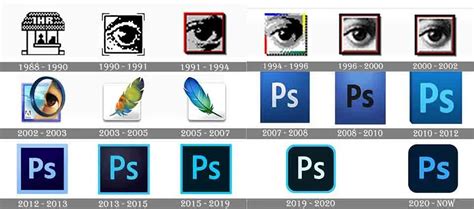
A Visual History of ADOBE PHOTOSHOP | The golden Journey of PHOTOSHOP
Ownership and the Adobe Ecosystem
Ultimately, Adobe Photoshop is owned by Adobe Systems Incorporated. The company acquired the distribution license from the Knoll brothers in 1988 and has since developed, published, and marketed the software. While the Knoll brothers were instrumental in its creation, their role evolved into that of developers and advisors, with Adobe holding the intellectual property and controlling its development and distribution.
Adobe's business model has expanded significantly beyond just Photoshop. The company now offers a comprehensive suite of software for creative professionals and enterprises, encompassing graphic design, video editing, web development, marketing, and document management. Products like Adobe Acrobat (and its ubiquitous PDF format), Adobe Illustrator, Adobe Premiere Pro, and Adobe After Effects are all part of the Adobe ecosystem, often integrated with Photoshop to provide a holistic creative workflow.
The company's financial success is a testament to its strategic decisions, including the acquisition of numerous smaller companies to enhance its product offerings and market reach. Despite facing competition and evolving technological trends, Adobe, and by extension Photoshop, has maintained its position at the forefront of the digital creative industry, continually adapting and innovating to meet the demands of a dynamic global market.
Continued Evolution and Future Prospects
As technology advances, so does Photoshop. The integration of Artificial Intelligence (AI) through Adobe Sensei has become a cornerstone of its recent developments, automating complex tasks and unlocking new creative possibilities. Features like Content-Aware Fill, Sky Replacement, and AI-powered selections demonstrate Adobe's commitment to leveraging cutting-edge technology to enhance user experience and creative output.
The company's journey, from its humble beginnings in a garage to its current status as a Fortune 500 company, is a compelling narrative of innovation and adaptation. Photoshop, as its flagship product, has not only defined the standards for image editing but has also become an integral part of countless creative processes worldwide, solidifying its owner, Adobe, as a dominant force in the software industry. The future promises further evolution, with Adobe continuously exploring new technologies and user needs to shape the next generation of creative tools.